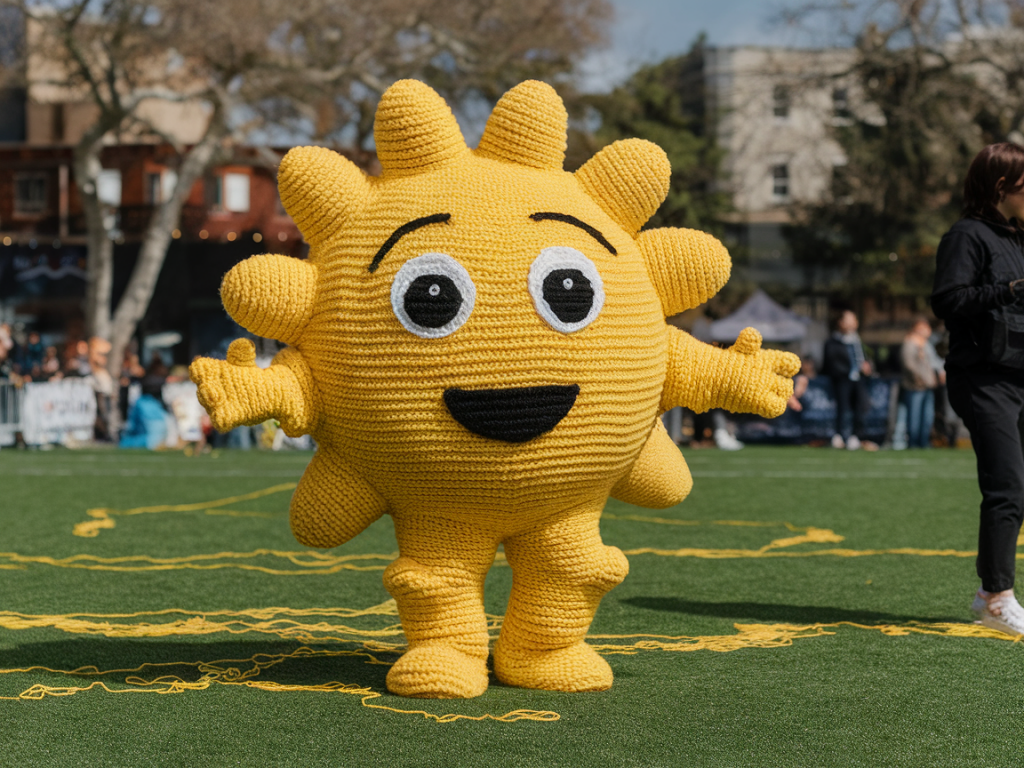
I still remember the first time I knit something meant to be seen from the other side of a festival field: a plucky, oversized hedgehog mascot with a jaunty scarf, perched on a promotional stall and drawing a steady stream of curious children. People asked me then — and keep asking — the same practical question: how much yarn do I really need for a festival-sized knitted mascot? It’s a deceptively simple question that depends on so many things: scale, yarn weight, stitch pattern, how wearable the mascot needs to be, and whether you plan to make it light enough to carry or heavy enough to withstand a weekend of hugs.
Define “festival-sized” — and why that matters
When I say festival-sized, I mean larger than a typical toy: roughly the size of a person’s torso up to a head-height prop. That could range from a cuddly 50–80 cm (20–32 in) tall plush mascot for stalls and photo ops, up to a wearable headpiece or full-body costume. The bigger you go, the more yarn you need — but not always in a linear way. Surface area increases with the square of linear size, so doubling height usually means roughly four times the yarn for the outer knitted shell.
Key variables to decide up front
My ballpark estimates
Below are rough guidelines that I use when planning a mascot. Think of them as starting points — I always add 15–25% extra yarn for safety (and because festival life loves a dropped stitch and a last-minute patch).
| Project type | Approx size | Yarn weight | Estimated yarn |
|---|---|---|---|
| Small festival mascot (plush) | 30–45 cm tall | DK/Aran | 600–800 m |
| Medium mascot (photo prop) | 50–80 cm tall | Aran/Bulky | 1,000–2,000 m |
| Large wearable headpiece | Head + neck; wearable | Bulky/Superchunky | 1,500–3,000 m |
| Full torso mascot (wearable costume) | Human-sized | Superchunky + fabric lining | 3,000–8,000 m |
Practical example: the hedgehog I mentioned used aran yarn and came in around 70 cm tall. Between the outer knitted spikes, inner body, scarf, and facial details I used close to 1,800 m of yarn — and I’m glad I had an extra skein for repairs after a lively weekend.
How I calculate more precisely
When I'm planning, I like to break the mascot down into components and estimate each separately: body, head, limbs, accessories, and surface features (like fur, tassels, or fringe). For each component I sketch dimensions and mentally convert to number of stitches based on my gauge.
Steps I use:
For a faster method, I often weigh a 10×10 cm swatch. If a 10×10 cm swatch weighs 10 g and you estimate the mascot’s knitted surface will be 4,000 times that area (which could be realistic for a large wearable piece), you’ll need 40,000 g of yarn — clearly extreme. The point is: weighing swatches gives a surprisingly reliable estimate when combined with a clear size plan.
Yarn weight and how it changes your approach
I reach for aran or bulky yarns for festival mascots because they knit up quickly and have presence on a stage or field. Brands I often choose:
Using superchunky yarn will reduce the stitch count and make your life quicker, but you’ll need more meters per skein and the feel changes: superchunky can look less detailed from close up. For wearable pieces, I often do the shell in bulky yarn and line it with mesh/quilting fabric so the wearer is comfortable and the structure holds.
Colorwork, embellishments and their hidden cost
Stripes and faces can eat up unexpected amounts of yarn. For example, a two-colour striped mascot may use nearly as much of the contrast colour as the main colour if the stripes are broad. I always estimate colours separately and buy an extra skein of every colour that’s used for large patches or patterning.
Embellishments such as fringe, pom-poms, or knitted spikes (I love making little cone spikes for hedgehogs) are yarn-hungry. Make a single sample of one repeated motif, measure how much yarn it took, and multiply by the count you plan to make — that’s saved me from a post-market panic more than once.
Structural tips to save yarn (and your back)
Packing for the festival and on-site repairs
I always bring a repair kit: a few matching skeins (or 50–100 g balls) of my main colours, spare needles, tapestry needles, and a small pile of safety pins and spare stuffing. If the mascot lives outdoors for a whole weekend, weatherproofing matters: consider a washable yarn (acrylic blends like Stylecraft or King Cole) and have a small roll of breathable vents/mesh if the mascot is wearable to ensure the person inside doesn’t overheat.
Last practical note: always buy yarn from the same dye lot for large projects, or alternate skeins every other row to avoid visible banding between lots. Festivals are all about the photo, and uneven colour bands will show on camera.
If you want, tell me the exact dimensions you’re planning and which yarn you prefer, and I’ll sketch a more precise yardage breakdown for your specific mascot. I love mapping yarn needs to a real-world sketch — it’s the part of the project that turns an idea into something that can stand, smile, and invite a crowd to your stall.