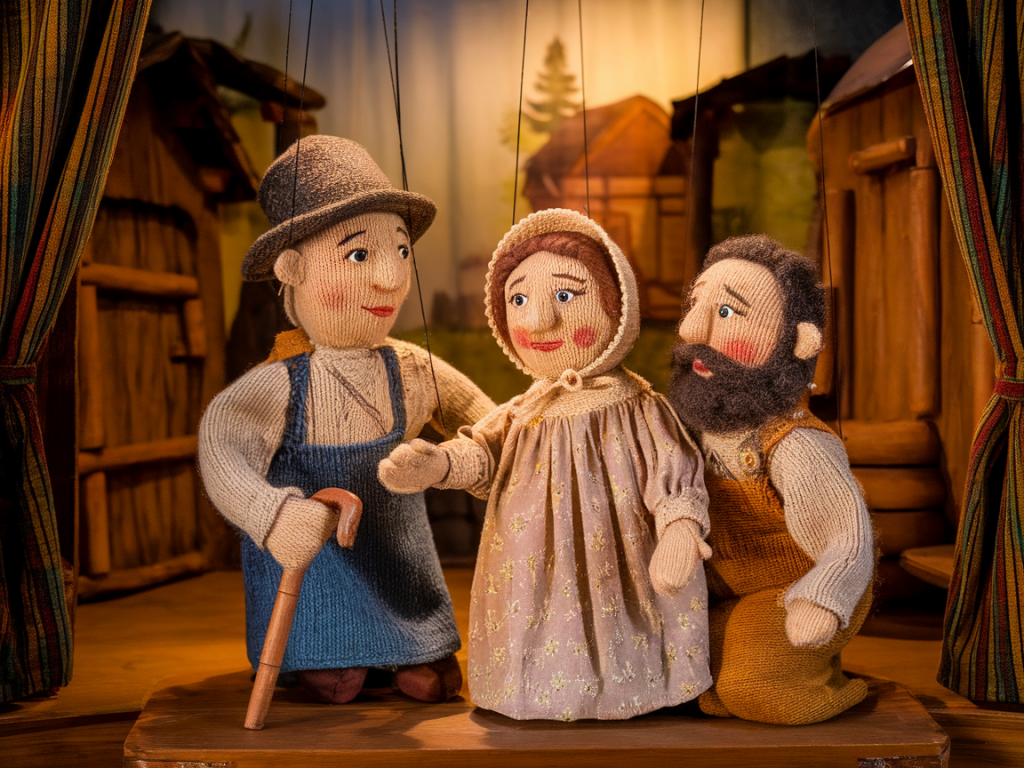
I often get asked how to put together a short, sharp puppet performance that still feels rich and rooted in folk tradition. Recently I set myself the challenge of building a 15-minute puppet set using three knitted characters and one folk song, and I want to share the recipe. This is the sort of thing I pack into a festival day bag: a tiny stage, a handful of props, and characters that carry a whole story in their stitches. Below I’ll walk you through materials, character ideas, simple staging, and a script outline you can adapt—so you can be ready to perform within an hour of finishing your knitting (or with knitted friends you already have).
Why a 15-minute set?
Fifteen minutes is a goldilocks length for many festival slots: long enough to tell a complete tale and let the audience breathe, short enough to keep attention and fit into busy line-ups. It’s also forgiving for makers who aren’t full-time puppeteers—your knitted characters can be simple in mechanics but rich in personality. The trick is to marry a compact narrative with a single, evocative folk song that anchors mood and movement.
What you’ll need (materials and kit)
Here’s a practical kit list I use. I keep a small pouch with these items so I can turn up at a market stall or a community hall and be performance-ready.
- Three knitted characters—each about 15–20 cm tall. I use wool DK yarn (Stylecraft Special DK is a reliable, festival-proof choice) and simple stocking stitch bodies so faces and costumes stand out.
- Basic puppet stage—a lightweight wooden frame or a folding cardboard box stage. I’ve bought a portable craft frame from Etsy sellers, but you can make one from an old cake box and a dowel rod.
- Hand rods or simple glove mechanisms—for knitted figures, hand-in puppetry works best: a lightweight glove or a small rod attached to the base for guiding movement.
- Props—three small items (cup, scarf, hat) and one larger item that’s central to the story (a stitched banner, a miniature concertina, or a paper lantern).
- One folk song chord sheet and backing—I play a guitar or use a small Bluetooth speaker with a backing track. If you play live, bring a capo and a compact instrument like a ukulele.
- Costumes and quick fixes—safety pins, sewing needles, spare yarn, and a glue gun for emergency repairs.
Choosing characters and their roles
Keep personalities clear and archetypal so audiences pick them up quickly. In my 15-minute set I usually make:
- The Inventor — curious, slightly distracted. Knitted in bright yarn with button spectacle details.
- The Storyteller — warm-voiced and wise, knitted with textured stitches like seed stitch to imply age and resilience.
- The Wanderer — light-footed and restless, in striped socks and a floppy hat.
Each one needs a single, dominant movement or prop: Inventor fiddles with gadgets, Storyteller unfurls a map or a scroll, Wanderer carries a lantern or a small bag. These repeated actions become performance anchors.
Picking the folk song
One song should set tone and be easy to weave into dialogue. Choose a tune with a simple chorus so the audience can hum along. I often pick trad songs in the public domain—like “The Water Is Wide,” “Scarborough Fair,” or a local folk tune if you have roots to it. If you plan to perform at festivals, check rights: public domain is safest.
Make the song functional in the script: it can be the object of memory, the reason they meet, or a communal call-and-response. Keep the arrangement short—two verses and a chorus typically suffice.
Structure: a compact narrative arc
A 15-minute set benefits from a clear three-act structure that mirrors the three characters:
- Act one (3 minutes): Introduction — Each character briefly appears and we learn their want. Use a short, catchy line for each to establish tone.
- Act two (8 minutes): The problem and song — The Inventor’s gadget fails, or the map is incomplete; the Storyteller remembers a song that might help; sing verse one and let the Wanderer react physically.
- Act three (4 minutes): Resolution — The song unlocks a solution or memory, objects are restored, and the chorus becomes a shared action (lighting the lantern, raising the banner).
Simple script outline (ready to adapt)
Below is a skeleton you can copy into your notebook and flesh out with local details or jokes:
- Opening: Lights up on Storyteller. “Have you ever heard a tune that could find a lost thing?”
- One-liners: Inventor pops in with “I made a thing!” —shows a tiny gadget that fizzes and fails.
- Inciting beat: Wanderer enters with a worn map. “This map never shows the same river twice.”
- Song cue: Storyteller hums the first verse. Characters respond with physical actions—Inventor mends gadget, Wanderer traces map.
- Climax: Chorus is sung in three-part call-and-response; the lantern lights (a little LED light prop) and the gadget springs to life.
- Farewell beat: Storyteller folds the map, “Some songs are roads.” Audience invited to clap or hum once.
Movement and puppetry tips
Because knitted puppets are soft and light, small, deliberate gestures read well. Practice these micro-movements:
- Head tilts for curiosity.
- Hand-to-heart for affection.
- Shared object passing to show connection—never make props disappear offstage mid-action; pass them visibly.
Keep voice distinct for each character. If you don’t feel confident changing pitch, vary rhythm and speech patterns instead: Storyteller speaks slowly, Inventor chatters, Wanderer uses short, wandering sentences.
Lighting, sound and accessibility
A small LED clip light and a speaker are transformative. Test sound at the venue beforehand. For accessibility, offer a printed lyric sheet for the chorus or invite a sing-along line so everyone can join. I also plan a tactile prop—like a knitted token—audiences can feel at the end during a meet-and-greet.
Quick rehearsals and timing
Rehearse with a stopwatch. Trim scenes that don’t move the story forward. A good rule: every line should either reveal character, move the plot, or support the song. Aim for 10–12 minutes of staged material so you have wiggle room for audience reaction or travel between festival acts.
Setlist and packing table
| Item | Purpose |
| Three knitted puppets | Characters and movement |
| Mini stage (folding) | Framing and focus |
| Bluetooth speaker / ukulele | Song accompaniment |
| LED light | Prop effect |
| Prop pouch (spare yarn, pins) | Emergency repairs |
If you try this at a festival—or in your living room—send a photo and tell me which folk song you chose. I love hearing how a small knitted ensemble can turn a single tune into a travelling story.