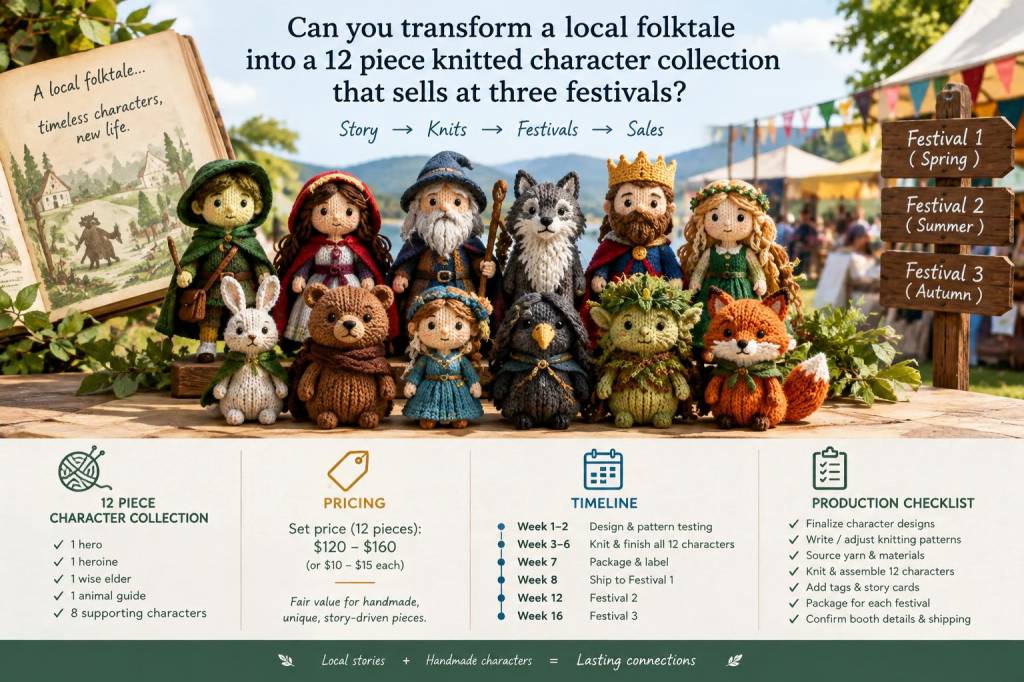
I once turned a local folk legend — a moonlit fisherwoman who could coax fish to dance — into a dozen little knitted people. The result was a 12-piece collection that I took to three summer festivals. People asked me afterward how I planned the whole thing: pricing, production, timeline, stock levels, logistics. Here’s the exact approach I used (and would use again), with practical numbers, a production checklist, and a realistic timeline so you can decide whether your folktale can become a travelling knitted collection that actually sells.
Decide what “12-piece collection” means for you
First, clarify whether your collection is 12 unique characters (my original approach), 12 units total, or 12 variations (e.g., 3 characters in 4 colourways). Each choice changes how you price, how quickly you can produce, and how you display at festivals.
My pick: 12 unique characters inspired by the tale. That gave a strong narrative hook — each doll represented a scene or persona from the story — which helped sales because visitors bought into the story as much as the object.
Costing and pricing — the math you need
People ask for formulas. Here’s the one I use:
Total cost per unit = Materials + Labour + Overheads + Packaging + Retailer/margin buffer.
Then choose a pricing strategy: direct festival retail (higher margin) or wholesale to shops (lower margin). Festivals are prime retail opportunities: buyers are in discovery mode and willing to pay for stories and handmade finish.
| Item | Example cost (GBP) | Notes |
|---|---|---|
| Yarn & stuffing | £6.00 | Good DK/sock yarn plus high-quality toy stuffing |
| Notions (buttons, eyes, felt) | £1.50 | Per unit averaged across bulk purchase |
| Pattern development / prototyping (amortised) | £2.00 | Design time spread across first batch |
| Labour (knitting and finishing) | £18.00 | Hourly rate x time; be realistic about finishing and sewing |
| Packaging (tag, bag, story card) | £1.50 | Essential: include the folktale summary |
| Festival fees/transport per unit | £2.00 | Pro rata share of pitch fee, travel, and accommodation |
| Total cost per unit | £31.00 |
With a total cost per unit of roughly £31, I aimed to retail each character at £65–£75 at festivals. That gives a comfortable margin to cover unsold stock, credit-card fees, and a buffer for future batches. For wholesale, a typical floor is 40–50% of the retail price — so wholesale would be around £30–£35, which barely covers costs. That’s why I only offered wholesale once every character had proven itself at festivals.
How many to make for three festivals?
Estimate festival footfall and the genre of the festival. For mid-sized folk festivals I attend, a conservative sell-through for a newly launched character is 20–40% per weekend if well displayed and priced. I therefore planned stock like this:
- Core pieces: 12 unique designs × 6 units each = 72 units total. This allowed a few sellouts and a healthy variety on the table.
- Reserve stock: An additional 12 units (mix of best-sellers) kept in the van for restocking between events.
- Display & demo pieces: 1 full set (12) for display only — these are beautifully finished and stay pristine.
That stock level let me rotate characters between stalls and gauge which designs resonated. I sold roughly 45–50 units across three festivals (a 62–70% sell-through of the 72 production units). My best sellers were the central character and two amusing side characters that had particularly expressive faces.
Timeline — realistic schedule for one maker
This timeline assumes you’re making most units yourself with some help for finishing or packaging. Adjust if you’re working with a team or outsourcing parts.
| Phase | Weeks | Tasks |
|---|---|---|
| Research & storyboarding | 1–2 | Choose 12 characters/scenes; sketch; source references |
| Pattern drafting & prototyping | 2–3 | Make 2–3 prototypes, refine sizes and construction |
| Materials sourcing (bulk) | 1 | Order yarn, stuffing, notions, labels |
| Batch knitting (first pass) | 4–6 | Target: 50% of stock; set daily goals |
| Finishing, embroidery, assembly | 3–4 | Buttons, faces, sewing seams, stuffing |
| Packaging, tagging, story cards | 1 | Design and assemble bundles |
| Pre-festival marketing & photos | 1–2 | Product shots, social media teasers, email to followers |
Total: about 12–19 weeks from idea to a box of finished pieces. If you have a production partner (seamstress, finishing helper) you could shorten active knitting time by half because tasks can run in parallel.
Production checklist — things you’ll wish you hadn’t forgotten
- Finalised size and weight spec for each character (helps with pricing and postage)
- Photographed prototype set in good light for promotions
- Story cards that explain the folktale connection — make these a selling point
- Secure bulk suppliers for yarn and stuffing (I use Deramores and Kingsley Dyers for colour consistency)
- Label and tag design (wash instructions, maker info, price)
- Packaging: biodegradable cello bags + card header, or a small muslin bag for a premium feel
- Inventory sheet per character (SKU, units made, units sold)
- Festival toolkit: portable display stands, tablecloth weights, card reader (SumUp or Square), float cash, tape, scissors
- Pricing stickers and a clear price list
- Insurance and licences (stall insurance, local rules about selling handmade toys)
- Transport plan and protective boxes to prevent squash
- Comfort items for the stall: chair, thermos, business cards, referral postcards
Practical sales and marketing tips I used
Tell the story often. A small printed folktale card tucked into each package increased perceived value and led to more impulse buys. I also offered a “set discount” — buy four characters, get 10% off — which encouraged multiple purchases and helped move slower designs.
Price signals matter. I found that a neat little kraft display with a handwritten sign “Hand-knit, UK-made, limited collection” allowed the £65 price to sit comfortably. For payment, a reliable card reader (SumUp) and clear price tags reduced friction.
If you want a PDF checklist or a simple spreadsheet template for costing and inventory, tell me which level of detail you need (solo-maker or small studio) and I’ll put one together for you.