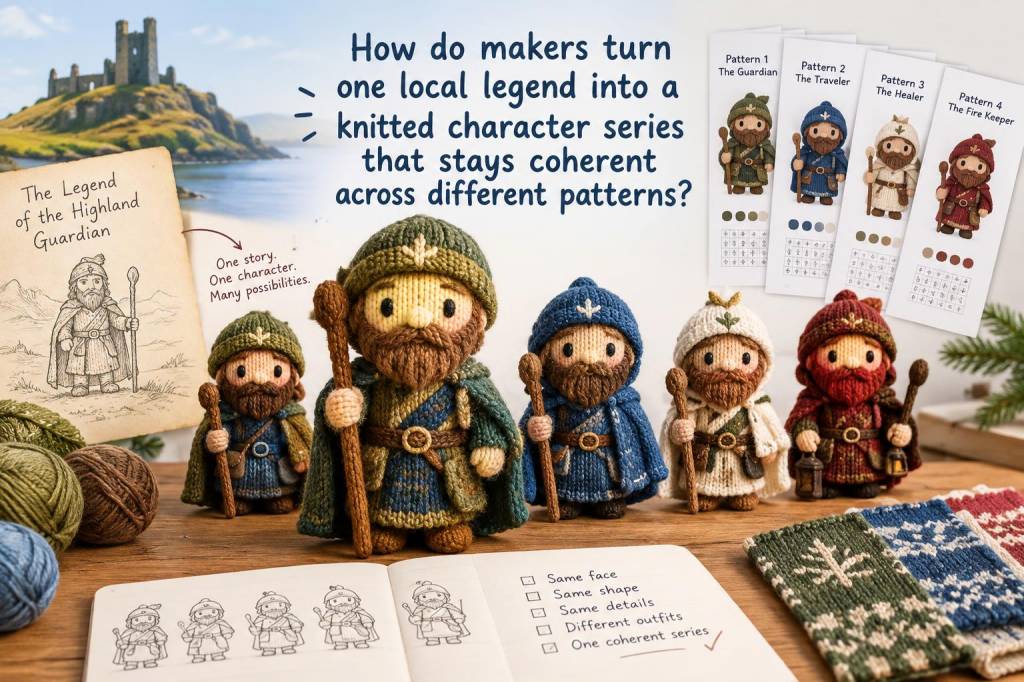
When I turn one local legend into a knitted character series, I begin by treating it less like a single pattern and more like a living family of designs. A strong legend carries mood, setting, gesture, and rhythm. If I translate only the most obvious details, I end up with one charming figure and a scattered set of later pieces. If I translate the structure of the story instead, I can create a series that feels connected from one pattern to the next, even when the characters differ in size, shape, and purpose.
For me, coherence starts long before yarn choice. I read the legend as if I were studying a costume archive, a village map, and a stage script all at once. I ask what remains constant across the tale: a colour, an object, a posture, a creature, a promise, a landscape feature, or a repeating phrase. Those repeated elements become my design anchor. They help me decide what must appear in every pattern so the series feels like one world rather than a set of unrelated toys.
Finding the core image inside the story
Every legend has a heartbeat. Sometimes it is a guardian spirit, sometimes a trickster, sometimes a forgotten saint, sometimes a local landmark that seems to watch over everyone. I look for that heartbeat first. If a legend speaks of a river that changes shape each spring, I may carry that flowing movement into every knitted character through curved hems, rippling stitch panels, or embroidery that looks like water paths. If the legend centres on a lantern bearer, I may repeat a tiny light motif, a pale glow in the colour palette, or a small carried object that appears in each design.
I try not to force too many details into one figure. A character series works better when each pattern carries a fragment of the legend rather than the whole weight of it. One figure may hold the key symbol, another may wear the shared colours, and another may echo the landscape in texture. That division lets the collection breathe. It also gives makers a reason to complete more than one pattern, because each finished character reveals a different layer of the same story.
Building a visual language that stays steady
Once I know the story core, I build a visual language and keep it steady across the series. This is where consistency matters most. I usually define a small set of rules for myself: a fixed yarn weight, a limited palette, a recurring stitch texture, and a consistent scale for eyes, hands, and feet. Those rules create family resemblance. Even if one character is tall and solemn while another is tiny and mischievous, they still seem to belong to the same legend.
I also like to repeat one signature design choice in each pattern. It might be a border stitch inspired by local dress, a button shape, a braided tail, or a small amulet sewn in the same place on every body. That repeated choice becomes a quiet thread linking the whole series. It is not loud, but it is memorable. Makers notice it, and so do readers who encounter the characters one by one over time.
Colour is one of my strongest tools for coherence. I usually choose a palette with one dominant shade, one support shade, and one accent shade. If the legend feels forested and dusk-lit, I may return again and again to moss green, charcoal, and ember gold. If it belongs to a coastal village story, I may reach for salt blue, faded cream, and weathered red. A unified palette keeps the series legible, especially when the shapes themselves become more playful or experimental.
Giving each pattern a role in the larger set
I do not want every pattern to do the same job. One character may introduce the legend, another may embody its tension, and a third may offer its gentler side. When I plan a series, I assign roles carefully. That allows me to vary the construction without breaking the sense of belonging.
For example, one pattern may be a simple standing figure for confident beginners, while another uses shaping, layering, or extra finishing details for more experienced makers. The simpler figure can carry the most recognisable symbol, so the story is accessible right away. The more advanced figure can explore nuance through texture or construction, deepening the legend for makers who want more challenge. In this way, the series grows like a conversation rather than a set of duplicates.
I think of each pattern as a chapter. If a reader encounters only one, it should still make sense on its own. But if they encounter all of them, the legend should expand in a satisfying way. That is why I avoid making each character too dependent on the others for meaning. Instead, I let them echo one another through detail, posture, and mood.
Using texture to carry memory
Texture is where legend becomes touchable. A story about stone, bark, waves, feathers, smoke, or woven baskets can live beautifully in stitch structure. I often choose one texture motif and repeat it in different placements across the series. A stone story may use bobbles and short rows to suggest uneven ground. A wind story may use lace panels or lifted stitches. A harvest story may use seed stitch, twisted rib, or cluster-like detail to suggest abundance.
I find texture especially useful when I want the characters to feel related without looking identical. The same motif can appear as a hem, a sleeve, a cape, or a decorative panel. Makers then recognise the shared language even when the silhouette changes. This helps the collection remain coherent while still feeling fresh from pattern to pattern.
Keeping construction language consistent
Coherence depends on more than appearance. Construction matters too. I usually settle on one or two familiar methods and keep them steady across the series. If one body is worked from the feet upward, I may use a similar flow for the others. If one head shape uses gradual shaping and minimal seaming, I may carry that approach through the rest of the collection. Familiar construction helps makers feel oriented, especially when they are moving from one design to another.
I also pay attention to finishing. I want the sewn joins, embroidered features, and accessory attachments to feel like they belong to one maker’s hand. That does not mean every step must be identical, but it does mean I keep my finishing principles consistent. I may always place eyes at a certain height, always use a similar mouth shape, or always attach decorative elements in a particular way. Those small decisions create a stable visual identity for the whole series.
| Series element | Purpose | My usual approach |
|---|---|---|
| Colour palette | Signals shared world | One main tone, one support tone, one accent tone |
| Texture motif | Links characters through touch and surface | Repeat one stitch idea in different placements |
| Construction method | Creates familiar making rhythm | Keep body and head shaping consistent |
| Signature detail | Marks the legend visually | Reuse one small object, symbol, or accessory |
| Proportion | Maintains family resemblance | Hold a steady relationship between head, body, and limbs |
Letting variation remain visible
A series becomes dull if every character feels too controlled. I always leave room for surprise. A legend has mystery in it, and I want that mystery to show up in the knitting. One figure might carry a slightly enlarged head to suggest wisdom, while another might have extra-long sleeves to suggest motion or magic. One may be quiet and upright, another lively and tilted, another wrapped in layers like a traveller. Variation keeps the series alive.
The trick is to make variation feel intentional. I ask myself whether a changed shape still belongs to the same story world. If yes, I keep it. If not, I simplify. This is where my editing eye matters as much as my creative one. I want the maker to feel delight, not confusion.
I also think about audience memory. When someone sees the second or third pattern in a series, they should recognise something from the first without needing a long explanation. That recognition can come from a sleeve shape, a recurring button, a familiar hat, or an embroidered line that behaves like a narrative refrain. Coherence is often built from these repeated small recognitions.
Working from legend with respect
When I use a local legend, I feel responsible for its tone and its roots. I do not want to flatten it into a cute mascot if the story holds grief, warning, or reverence. I try to listen carefully to what the community values in the legend. Sometimes that means making a character gentler than expected. Sometimes it means keeping a stern expression or a restrained colour scheme because the story asks for seriousness.
This is also why I prefer research before invention. I look at regional images, oral versions, festival references, and local craft traditions. Those details help me avoid a vague fantasy version of the tale. They also give me material for consistency. A recurring pattern in a shawl, a way a cloak is fastened, or a local motif on a sign can become a design thread across the whole series.
When I feel unsure, I return to the legend’s emotional centre. Does it protect, warn, mourn, celebrate, or transform? That answer shapes the characters more than any decorative flourish. If the story is about protection, then every pattern should carry some sense of shelter. If it is about transformation, then I may allow the series to shift gradually from one figure to the next, so the collection itself tells a change story.
Helping makers recognise a shared family of patterns
I want makers to feel that they are joining a collection, not solving a puzzle. So I give them enough continuity to feel grounded and enough variety to stay curious. A short design note at the start of each pattern helps me do that. I may explain the repeating motif, the shared legend source, or the reason a certain colour or texture returns. That context can make the making experience feel richer and more connected.
When a series works well, makers often begin to spot the hidden links themselves. They notice that one character’s cloak mirrors another’s hem, or that a tiny symbol appears in different forms throughout the collection. That moment of recognition is one of my favourite parts of design. It means the legend has become legible through stitch, and the whole series has started to speak with one voice while still offering distinct personalities.
I keep returning to that balance: unity without sameness, variation without drift. A local legend can support many knitted characters, but only if I treat coherence as a design principle from the very first sketch. The more carefully I hold the shared language, the more freedom I can give each pattern to surprise, delight, and carry a different piece of the tale.