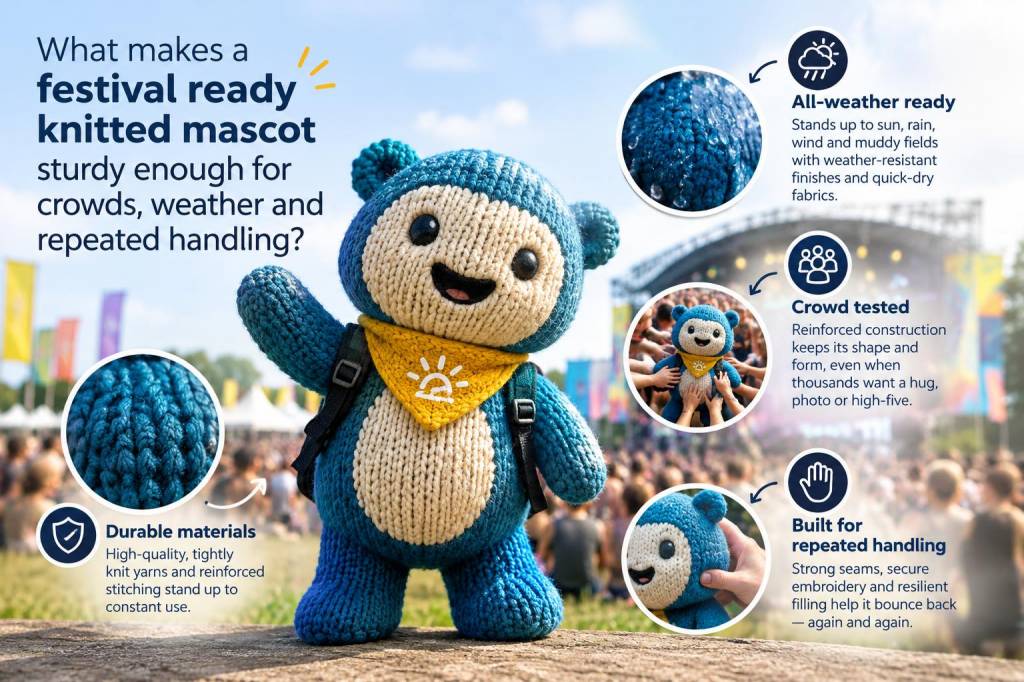
I have learned, through many damp field days and crowded village greens, that a festival-ready knitted mascot must do more than look charming in a photograph. It must survive being carried, hugged, pinned to a stall, clipped to a banner, brushed by rain, squeezed by curious children, and lifted again for one more round of attention. When I make one, I am thinking about motion, weather, and repeated handling as much as I am thinking about expression and personality. A mascot for a festival is not a display piece sitting still in a cabinet; it is a companion that enters a noisy, changeable, very human environment.
What makes a knitted mascot sturdy is not one single choice. It is a whole chain of decisions, from yarn selection to stuffing to seam finishing to the way I attach every small feature. If one part is weak, crowd energy will find it. A loose arm will tug. A floppy ear will twist. A delicate embroidered smile may fade into a smear after enough handling. So I build with durability in mind from the first stitch, while still protecting softness, warmth, and character.
Strong yarn choice shapes everything
I begin with fibre, because fibre determines much of what the mascot can endure. For public events, I usually prefer a tightly spun yarn with a smooth surface and reliable twist. That kind of yarn resists pilling better than a fuzzy, lofty yarn, and it holds stitch definition in a way that keeps faces and small details readable from a distance.
Wool blends often serve me well, especially when they include a little nylon or acrylic for added resilience. Pure wool can be lovely, but if I know a mascot will spend long hours on a table or be handled by many different hands, I like a fibre with extra recovery. Cotton can work too, especially for warmer weather, though it may feel heavier when wet and can stretch if the structure is not carefully reinforced. I avoid anything too delicate, too silky, or too loosely spun if I expect rough use.
Colour also matters more than people think. Bright shades attract attention in a festival crowd, but I want dyes that stay stable under sun and repeated contact. I test for colourfastness when I can, especially if I plan to use the mascot outdoors. A strong visual identity means very little if the colours bleed after a sudden shower or fade halfway through the season.
Structure inside the charm
A mascot may look playful and soft from outside, but inside I build a structure that behaves like quiet armour. I often use firm stuffing, packed evenly, so the body keeps its shape instead of collapsing into a baggy lump. For limbs, ears, snouts, or wings, I may add a denser core or use a slightly firmer fill at the base so those parts do not droop after hours of display.
When I want real stability, I think about balance. A mascot with a broad head and tiny feet can tip over easily, so I may widen the base, add weight in the lower body, or design a seated posture that lowers the centre of gravity. For larger pieces, I sometimes include a hidden fabric lining or an internal support layer, especially if the mascot will be carried on a stand, attached to a costume, or placed beside a stage area where wind is a factor.
If a mascot must withstand frequent handling, I avoid overstuffing to the point of distortion. A shape that is too rigid can split along a seam when squeezed. I want firmness, not brittleness. The sweet spot is a body that rebounds after pressure, keeps its outline, and still feels inviting in the hand.
Seams, joins, and stress points
Most failures happen where pieces meet. That is where fingers pull, where children grab, and where motion concentrates over time. I always reinforce joins. If I am attaching limbs, I use secure sewing with extra passes at the connection point. If I am making a face, I anchor it deeply instead of relying on a few decorative stitches. For anything likely to be touched often, I prefer stitched features over glued ones, because sewing gives me more control and usually lasts longer.
I pay close attention to the neck, shoulders, ankles, and any narrow transition between a large piece and a smaller one. These areas carry strain during handling. I often add internal stitching or hidden reinforcement thread in those zones. If the mascot has a handle, hanger, or fastening point for display, I strengthen that attachment several times over. A festival crowd is not gentle by design, and I never assume a decorative join will behave like an industrial one unless I have built it that way myself.
For facial features, I try to keep raised elements small and well anchored. Loose buttons can be unsafe in busy public settings, so I usually embroider eyes or use securely fixed felt details if the mascot will be near children. I want a design that feels friendly without becoming fragile. The simplest face is often the safest face.
Weather changes everything outdoors
Festival weather can shift quickly from bright warmth to cold drizzle in a single hour. That means I think about moisture, drying time, and shape retention before I ever pack a mascot into a bag. Wool has a natural advantage in light damp conditions because it can resist odour and retain some warmth, but it still needs care. Once saturated, even a strong knitted object can sag if its stuffing absorbs too much water.
For outdoor use, I choose yarn and stuffing with weather in mind. I keep away from materials that trap water excessively or take too long to dry. If I know a mascot may be displayed in uncertain weather, I often make a removable outer layer or protective cover so the main piece can stay dry between appearances. I also think about sun exposure, since prolonged light can fade colour and weaken some fibres over time.
Storage matters just as much as fabric choice. After a wet event, I dry the mascot slowly and fully, away from direct heat that might distort the fibres. I never want a damp item packed away in a hurry, because mildew and smell can do more damage than one rainy afternoon. A sturdy mascot is one that can recover after the weather turns against it.
| Design Choice | Durability Benefit | Festival Risk Reduced |
|---|---|---|
| Tightly spun yarn | Stronger surface, less pilling | Wear from repeated handling |
| Firm, even stuffing | Stable shape and better rebound | Collapse and distortion |
| Deep stitched joins | Secure attachment of parts | Limbs or features pulling free |
| Low-profile embroidered face | Fewer snag points | Damage from crowd contact |
| Moisture-aware fibre choice | Better performance in outdoor conditions | Stretching, sagging, slow drying |
Handling by many hands needs practical design
I have found that a festival mascot succeeds when it can be touched without fear. That means I design with touch in mind. Smooth surfaces are kinder to crowds than shaggy textures that snag on jewellery or rough sleeves. Secure appendages are better than loose decorative bits that invite accidental pulling. If I want a mascot to be passed around or held for photographs, I make sure it has a stable grip point or a shape that sits naturally in the palm.
Scale matters too. A very small mascot may disappear in a crowd and get lost in pockets or bags. A very large one may become awkward and vulnerable to strain. I like a size that feels substantial enough to command attention but light enough to carry comfortably all day. If I make a larger piece, I plan for transport as carefully as I plan for display. A mascot that cannot be moved without damage is not truly festival-ready.
I also think about maintenance during the event itself. Can it be brushed clean quickly if dust collects on the stall? Can I freshen it between audience interactions? Can it survive being placed on a wet bench or a crowded table for an hour? These ordinary questions matter because festivals are ordinary chaos wrapped in celebration. A truly sturdy mascot accepts that reality.
My finishing habits make a difference
I have a few habits that save a lot of trouble later. I weave in ends with care and secure them well so they do not work loose after rubbing and movement. I block pieces only when appropriate, because over-blocking can flatten character out of a design that should remain lively. I inspect every seam under good light before an event, and I tug each part gently to see where stress might appear under real conditions.
When I add accessories, I ask whether they can survive crowd contact. A tiny scarf might be lovely, but if it unravels easily, I either reinforce it or remove it. A stitched patch can be more effective than a separate ornament. Even decorative fringe needs a purpose if it is going to live through a public day.
I am also mindful of repair. A mascot that can be mended easily has a longer life. I prefer construction that lets me access problem areas without dismantling the whole piece. If something starts to loosen after several festivals, I want to repair it quickly and keep the personality intact. Longevity is part of sustainability, and sustainability is part of respect for craft.
What I look for before a mascot leaves my worktable
Before I pack a mascot for a festival, I run through a quiet mental checklist. I want to know whether it can sit upright, whether its features stay put when nudged, whether its yarn feels resilient rather than fragile, and whether moisture or sunshine are likely to trouble it. I look for signs that the object can endure ordinary human attention without losing its charm.
- Firm body shape that does not collapse under light pressure
- Secure seams with no visible strain at joins
- Low snag risk from smooth surfaces and anchored features
- Weather awareness in fibre, stuffing, and storage plan
- Comfortable handling for hands of different sizes and ages
- Easy repair if anything loosens after repeated use
When all of those elements work together, I get a mascot that feels alive in the best sense: not fragile, not precious, but ready. Ready for noise, ready for movement, ready for a crowd that wants to touch it, photograph it, and carry a little piece of its personality home. That readiness is what turns a knitted figure from a clever object into a festival companion.
And when I stand near a busy stall and see a mascot holding its shape after hours among windblown bunting, sticky fingers, camera flashes, and sudden weather shifts, I know I have done more than make something cute. I have made something that can participate in the life of the event, endure it, and still look as if it belongs there.