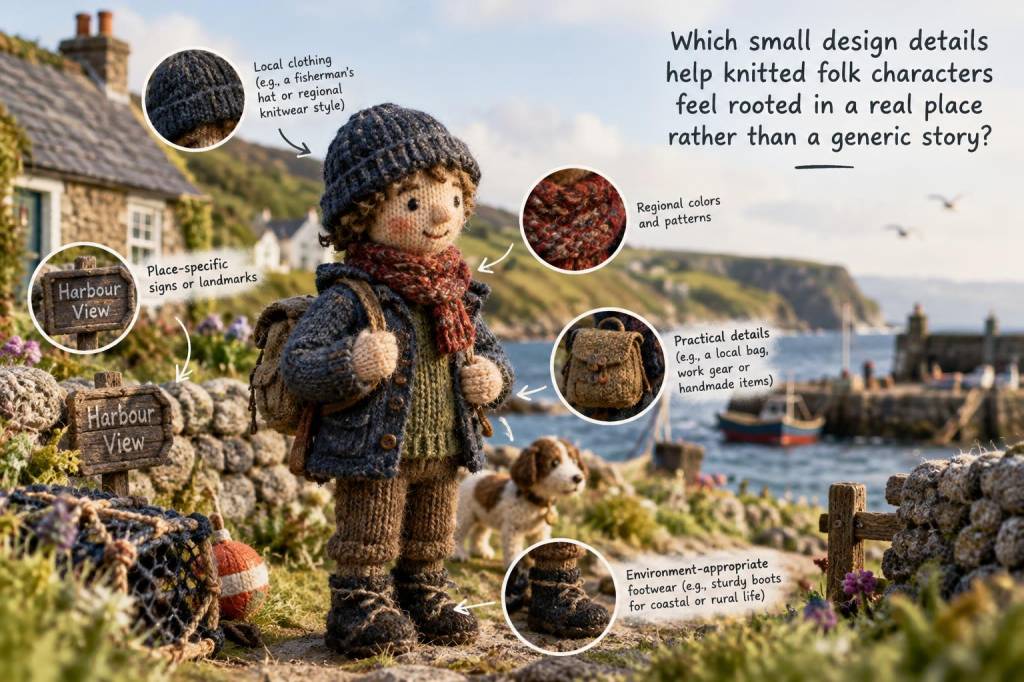
I keep coming back to a simple truth: a knitted folk character feels alive when a small design choice quietly says, someone from a real place could have made this. Not a fantasy of “any village anywhere,” but a figure shaped by weather, work, local habits, and memory. When I am designing or describing one of these characters, I look for details that carry geography in a subtle way. I do not mean a costume packed with obvious symbols. I mean the tiny, almost shy elements that make a reader feel the ground beneath the character’s feet.
Clothing That Reflects Local Use
I always begin with clothing, because clothing is often where place shows itself most naturally. A generic knitted character might wear a neat jumper, a scarf, and boots. A character rooted in a real setting wears things that make sense for daily life in that region. A seaside fisherfolk figure may have a heavy oilskin-style coat, a cap shaped to resist wind, and sleeves that look worn at the cuffs. A mountain village character might wear layers that are practical rather than decorative, with a shawl pinned tightly at the neck and stockings built for cold paths.
What matters most is not perfection, but usefulness. When I knit tiny garments, I ask myself what the character would need on an ordinary morning. That question often leads to design choices that feel specific without becoming theatrical. A shortened sleeve, a patched elbow, or a skirt hem lifted slightly to avoid mud can say more about place than a bright, symbolic badge ever could.
Colours Drawn From Surroundings
Colour is one of my favorite ways to root a character in place. I do not reach first for the most cheerful palette. I look instead at what a landscape seems to have left behind in the memory of the people who live there. Is the place full of peat, stone walls, rain-dark wool, salt light, or yellow gorse? Is it a market town with brick lanes and brass signs, or a high valley where moss and slate dominate?
When I use a local palette, I am careful not to flatten it into a postcard. Real places contain quiet, mixed tones. A coastal village is not only blue and white. It may have rust from harbour railings, green from seaweed, cream from weathered paint, and a reddish brown from old rope and mud. These colours, even in miniature yarn, give the character a lived-in sense of belonging. They suggest that the figure has walked through lanes, leaned against walls, and absorbed the landscape rather than merely standing in front of it.
Small Tools, Small Habits
I find that objects often do more work than clothing. A basket, a walking stick, a lantern, a music case, a market apron, or a folded cloth can place a knitted character immediately. Still, I try to choose objects that feel earned. The item should look like something the character actually uses, not a prop handed to them for effect.
For example, a bread seller in a festival story might carry a cloth-lined tray rather than a polished basket. A reed player might have a strap that sits awkwardly across one shoulder because it has been repaired many times. A flower gatherer might tuck stems into a makeshift bundle tied with string, not satin ribbon. These are tiny things, but they create a strong sense of reality because they speak of habit, economy, and improvisation.
I also like to show wear. A slightly bent brim, a handle wrapped in thread, or a pocket that dips lower on one side can suggest repeated use. That kind of detail makes me trust the character more. It tells me they belong to a working world, not a stage set.
Local Craft Language In The Stitching
One of the most satisfying ways to signal place is through stitch texture. Different regions and traditions carry different craft memories, and I try to let that shape the surface of a character. A dense, close fabric can suggest protection from wind or rain. A looser texture may hint at warmer weather, open fields, or garments made in haste for a fair day.
I am especially drawn to textures that echo local craft traditions without copying them too rigidly. A ribbed section can recall practical workwear. A patterned panel may echo weaving, knitting, or embroidery found in regional dress. Even a simple garter stitch body can feel specific if I vary the tension, shaping, or finishing to reflect a particular handmade tradition.
What I avoid is decorative overload. If every inch of the character is packed with pattern, nothing feels local anymore. Real places do not announce themselves all at once. They reveal themselves in layers. A character may have a plain body with one traditional motif at the cuff, a collar shaped like a known regional garment, or a hat edge that echoes a local cap style. That restraint often makes the place feel more believable.
Weather As A Story Clue
Weather is one of the strongest markers of place, and I try to let it shape both design and posture. A character from a windy coast does not stand in the same way as one from a sheltered inland valley. A damp climate changes hems, hats, shoulders, and even the way a knitted character might carry a shawl. A character from a sun-baked fairground will look different from one designed for misty dawns and drizzle.
I like to imagine how weather would change the character’s body language. Do they lean forward against the wind? Do they wear a hood pulled low? Are their boots slightly muddied? Has rain darkened their wool tones? These cues are small, but they place the character in a climate that feels lived rather than imagined from a distance.
Even the face can reflect climate. A flushed cheek, a squint, or a tiny scarf wrapped high under the chin can suggest conditions without needing explanation. The result feels intimate, almost documentary, even when the character is whimsical.
Age, Trade, And Local Rhythm
Real places shape people through work and rhythm, so I often ask what the character does from day to day. That question changes everything. A market baker will stand differently from a bell ringer. A shepherd will carry their body with another kind of balance. A festival steward, a river guide, or a stall keeper will each suggest a different relationship to space, time, and movement.
I think this is where many knitted folk characters become generic: they are given a “folk” look without a life pattern. I prefer to give them a task, then let the task mark the design. A character who sorts apples may have a practical apron pocket. A character who mends nets may have hands shaped for grasping. A character who tends lanterns may have soot-darkened sleeves. The place then appears not through scenery, but through labour.
Age matters too. A younger character may wear hand-me-down items that feel slightly too large. An older one may carry clothing that has been adjusted many times. A patched hem, a reworked collar, or a reused button can imply family history and local continuity. Those details make a character feel as if they belong to a household, a lane, and a set of stories rather than to an abstract “tradition.”
Names, But Used With Care
I am cautious with names, because a name can either root a character or push them into stereotype. A good name often sounds natural in the community the character comes from, but it should not be forced into sounding “folkloric” for its own sake. I often think about whether the name has local rhythm, whether it belongs to a working family, and whether it matches the character’s age and role.
Sometimes a nickname does more than a formal name. A character known as Moss, Willow, Pike, or Tilly may feel more immediate than one given a grand label. Nicknames can hint at landscape, family habit, or occupational identity. They also make the character feel spoken about by neighbors, which is exactly the kind of social texture I want.
Signs Of Community Rather Than Solitude
I rarely design a folk character as a solitary figure only. Real places are made visible through relationships, so I look for small signs that the character lives among others. A shared colour with another figure, a repeated motif across different garments, or a similar style of footwear can suggest family or community ties. A scarf made from the same yarn as a nearby market stall banner can suggest local exchange.
When I build a group of characters, I like each one to carry a different part of the place’s identity. One may reflect fishing, another farming, another music, another seasonal celebration. Together they create a fuller portrait than any single character could. Even if a reader only meets one of them at first, I want that person to feel embedded in a wider social world.
| Design detail | Place signal | Effect on character |
|---|---|---|
| Weathered hem | Rain, mud, long walking routes | Suggests daily use and local climate |
| Muted earth tones | Stone, soil, peat, timber | Makes the figure feel tied to landscape |
| Practical tool | Local work or trade | Gives the character a believable routine |
| One regional motif | Craft memory or inherited pattern | Creates specificity without overload |
| Visible repair | Reuse, thrift, continuity | Suggests history and care |
What I Notice When A Character Feels Real
When a knitted folk character truly feels rooted in place, I notice that my imagination slows down. I stop seeing “a folk figure” and start seeing a person who belongs to a specific lane, shore, field, or market square. I sense their weather, their work, their neighbours, and their habits. That shift usually happens because of very small design details rather than grand storytelling gestures.
A slightly crooked hat. A colour that echoes wet stone. A basket lined with cloth instead of decoration. A stitch texture that hints at local making. A coat that has been mended with care. Each detail says, quietly but clearly, that this character has a past in a real place. And that, for me, is where knitted storytelling becomes strongest: not when it becomes louder, but when it becomes more particular.