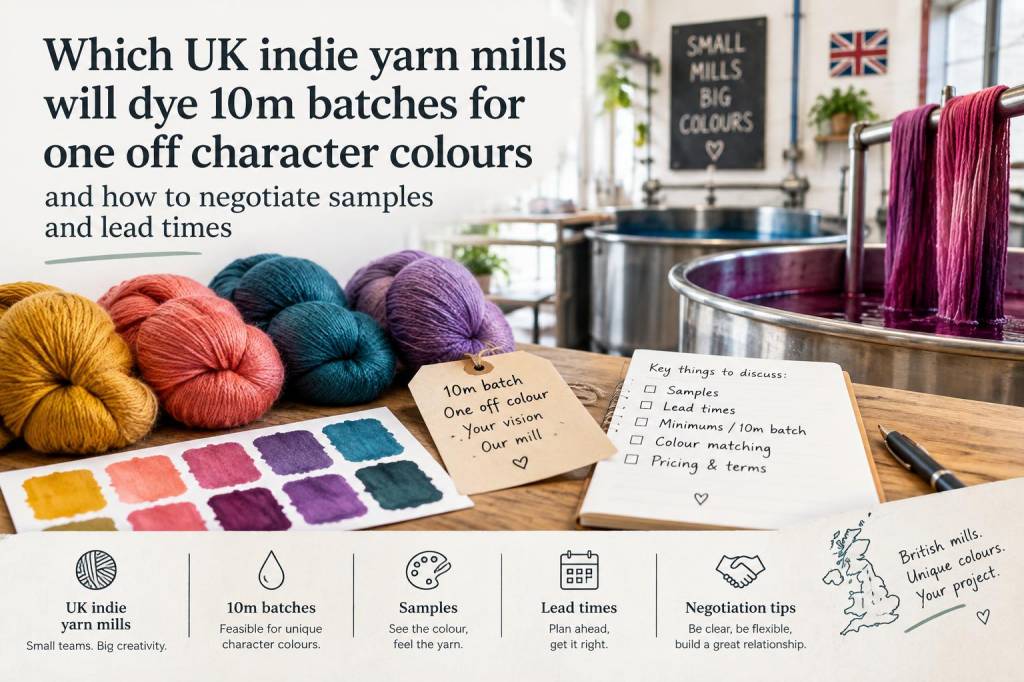
I’m often asked by fellow makers who design tiny, one-off knitted characters: where can I get a single shade dyed in a very small run — say a 10m batch — and how do I negotiate samples and lead times without blowing my budget or my launch schedule? I’ve spent years sending swatches to mills, trading emails with dyers, and juggling lead times around festival stalls, so here’s a practical, honest guide to what to expect and how to get the best outcome.
Which UK indie mills are worth contacting
First, a reality check: most traditional mills and commercial dyers work in weight or skein minimums rather than by metres, and their smallest practical runs are often larger than a single 10m sample. That said, several UK small-scale mills and contract dyers are set up to work with makers and designers on custom colours and small batches. They’ll either dye commercially produced yarn for you, or offer in-house blends with small minimums. Some names I’d start with:
John Arbon Textiles — a small-scale mill in Devon that blends, spins and dyes genuine small-batch yarns. They’re used to working with designers and indie brands for custom runs.Eden Cottage Yarns — a Yorkshire-based operation, known for small-batch speciality yarns and commercial dyeing relationships. They sometimes offer limited custom dye options.Jamieson & Smith — a long-established Shetland mill. They’re more traditional and may require larger minimums, but their heritage yarns and island-dyed colours are lovely if you can align with their production windows.John Arbon Contract Dyeing and small contract dyers — many mills offer contract dyeing services for third-party yarn bases; ask if they’ll accept small lots.Local co-ops and smaller craft dyers — some hand-dyers and micro-mills will take tiny, studio-scale orders. They’re not always advertised, so a direct email or a phone call often uncovers possibilities.Note: some well-known indie dyers (eg, Fyberspates, West Yorkshire Spinners) focus on established product ranges and may not accept tiny one-off dye runs — or might only do them at a premium. Always ask; policies change.
How to approach a mill: what to ask and why
When contacting a mill, be concise and intentional. Answer the questions they’ll ask before they ask them. Key points to include:
What yarn base (fibre content, ply, and preferably a supplier SKU) do you want dyed?What exact quantity — if you mean 10m, be explicit (10 metres of single-ply DK = how many grams or m?)Is this a one-off shade or part of a repeatable dye recipe?Do you need labels, winding, skeining or cone ends?When do you need first samples and full delivery?Are you on a strict budget or open to premium pricing for small batches?If you’re unsure about gram/metre conversions, include the weight and wraps-per-inch (or request their advice). It shows you’ve done your homework and speeds up their costing.
Negotiating samples and lead times
Here are tactics I use every time I need a bespoke shade for a character project:
Ask for a lab dip or colour proof first. A small mini-skein or a 10–20g sample (not just a photo) should be the first paid sample. This lets you check dye take-up on the actual base.Be willing to pay for a working sample. Expect to pay a setup/sample fee — this covers mixing, the dyer’s time, and small-scale loss. Think of it as part of product development, not a freebie.Bundle needs where possible. If you’re planning multiple colours for an entire character collection, negotiate samples for several shades at once. Bulking increases your negotiating power.Ask about a tiered lead time. Some mills will offer fast-track samples (for a fee) and standard lead times for the production run. Decide which deadlines are immovable — festival launch dates, for instance — and state them early.Negotiate minimums. If the mill has a minimum larger than you need, ask for a partial order with the remaining yarn sold back to you as cut wash-ends or smaller skeins. Some mills will sell you a portion of a minimum if you accept colour-matching risks.Plan for rematch charges. If you want an exact repeat of a sample later, ask how the mill handles metamerism and repeat runs, and whether they hold the recipe.Request a written production timeline. Confirm sample approval turnaround, dyeing window, finishing, winding and shipping dates.Be clear about payment terms. Many mills ask for a deposit on custom runs. Clarify cancellation policies and waste handling up front.Use firm but polite deadlines. “I need a sample by [date] to make my festival market date” is more effective than “as soon as possible.”Estimated minimums, costs and lead times (indicative)
| Service | Typical minimum | Sample fee | Lead time (samples) | Lead time (full run) |
| Small studio dyer | 10–200m (varies) | £5–£30 | 3–10 days | 1–4 weeks |
| Contract dyeing at indie mill | 1–5 kg (often higher) | £30–£150 | 1–2 weeks | 4–12 weeks |
| Heritage mill (eg. island mill) | Higher minima (ask) | £50–£200+ | 2–4 weeks | 8–20 weeks |
These are indicative ranges based on conversations with makers and mills. Prices and minima vary hugely by fibre, yarn construction and mill workload.
Practical tips for colour matching and quality control
Send a physical reference. Photos can be useful, but a little swatch or a printed Pantone is far better. If you want a character’s blush or a festival tent green, send the actual knitted scrap.Test the base. Different bases take dye differently. A 4-ply merino and a blended DK will read lighter/darker. Ask for the sample to be washed and blocked so you see the final effect.Keep lighting consistent. Evaluate samples under daylight or a lightbox. Dyes can look very different under tungsten or LED stall lighting.Record everything. When you approve a sample, request the dye recipe, lot numbers and any special process notes. If you plan repeats, this is gold.Sample email template you can adapt
Below is a short template I use that gets quick responses. Tweak the specifics for your fibre and dates.
Subject: Custom dye enquiry — small sample & possible one-off run
Hi [Name],
I’m a designer/maker looking to commission a small custom dye for a character project. I’d like to check if you can dye [fibre base and SKU] — target quantity ~10m (or state weight) of [fibre]. I’d like one lab-dip/sample skein first (approx. 10–20g) and, if approved, a one-off batch of [total metres/grams].
Key dates: sample required by [date]; full delivery by [date]. Could you confirm:
whether you can take this order;sample fee and sample lead time;minimum batch size and estimated cost for the full run;deposit and payment terms;your policy on colour repeat and whether you’ll hold recipes.I can send a physical swatch and further specs on request. Happy to pay for the sample and for a rush service if available. Thanks for your time — I look forward to hearing if this is possible.
Best,
[Your name]
Final practicalities — what I do before a festival
Order samples early — never the week before a fair.Keep a small buffer stock to cover dye variability and damaged skeins.Label every sample with lot numbers, recipe notes, and the mill contact for easy repeats.Build relationships: a friendly, reliable relationship with one or two mills makes negotiations and rush jobs much easier.If you want, I can help draft your first email to a mill or look over a sample approval message before you send it. I’ll also happily share the wording I use when I need a colour rematch — it saves a lot of back-and-forth at crunch time.