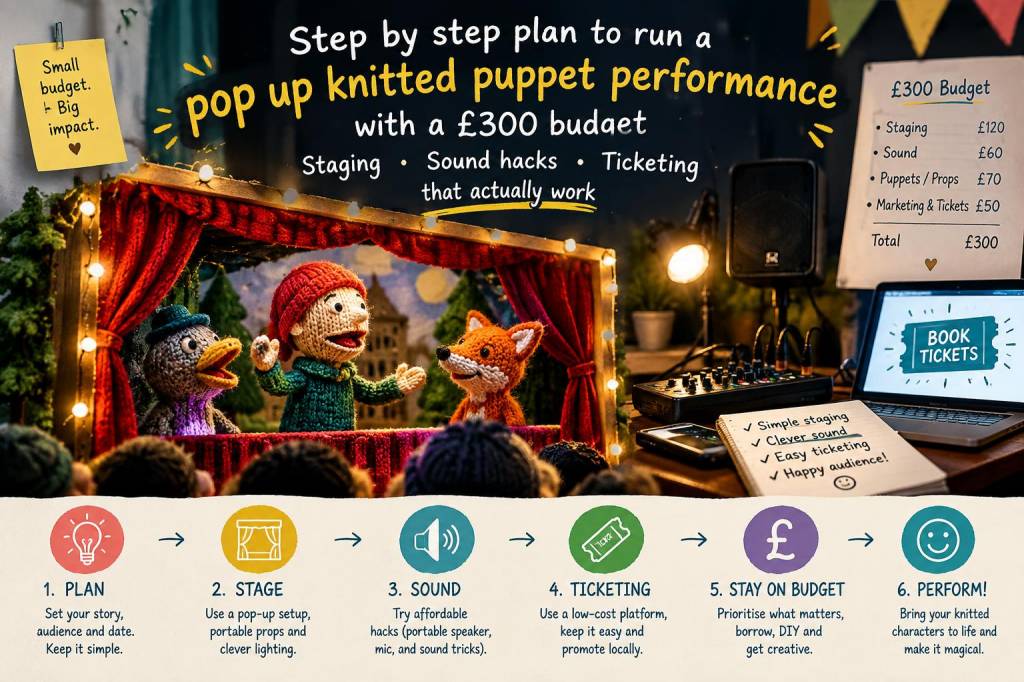
When I started taking my knitted characters out of the living room and into festival fields, I had two stubborn constraints: a love for intimate, handcrafted theatre and a shoestring budget. Over the years I’ve learned how to make tiny casts of woolly puppets feel big, how to stage on a shoestring, and how to sell tickets without drowning in fees. Below is a step-by-step plan I use when I’m asked to run a pop-up knitted puppet performance with a budget of roughly £300. It’s practical, festival-friendly, and keeps the magic intact.
What you’ll achieve with £300
In plain terms: a simple but charming stage area, basic sound that actually lets audiences hear the characters, a clear schedule, and ticketing that covers costs and respects your audience. You won’t be building a full theatre, but you will create a memorable, repeatable experience that fits into folk fairs, makers’ markets, or a village green slot.
Quick budget breakdown (use as template)
| Item | Estimated Cost |
|---|---|
| Portable simple staging / backdrop | £60 |
| Sound - small PA or speaker hire | £80 |
| Lighting (battery LEDs) | £20 |
| Props & materials (glue, fabric, fastenings) | £30 |
| Print & promo (posters, flyers) | £20 |
| Tickets & box office (apps/fees) | £10 |
| Transport & contingencies | £50 |
| Total | £270 |
Leave a small margin in your planning for unexpected costs — that’s the contingency line. These numbers reflect UK prices as of my last few festivals; swap hire for purchased low-cost goods if you plan to repeat the show.
Step 1 — Choose a compact set that tells a big story
I always start with the story, then pare down the set. Knitted characters thrive in close quarters: audiences like to see the stitches, the expression, the tiny props. Design a backdrop that is lightweight and modular — I use a folding banner-frame (think cheap pop-up display) or a painted canvas pinned to a simple A-frame.
Practical materials:
Step 2 — Sound hacks that don’t cost a fortune
One of the biggest mistakes I see is relying on the charm of the craft alone and ignoring sound. At outdoor events, even a stitched soliloquy can be lost. You don’t need a sound engineer — you need intelligible, warm sound.
Options depending on budget:
My preferred hack: a small battery PA plus a headset mic. If you can pre-record some ambient sounds or songs on your phone, you can play them through the speaker rather than relying on live accompaniment.
Step 3 — Lighting that adds atmosphere (without mains)
Natural light is your friend, but festivals run late or move into darker marquees. For under £20 I build a wash with battery-powered LED strips or clip-on lights. They’re light, safe, and give me a warm glow that flatters wool colours.
Step 4 — Puppetry staging and flow
Think about sightlines first. People will cluster; some will sit on nearby bales, some will stand. I design the show so the main action sits at chest height for adults — that way kids and seated audience members can see. Keep scene changes beneath 30 seconds, and have the next puppet ready behind your knees or on a hook.
Step 5 — Ticketing that actually works
Ticketing can be where budgets are eaten by fees. For pop-up performances I aim for simplicity and fairness.
Pro tip: release a limited number of pre-booked tickets (50–70%) and keep some free for walk-ins. That creates urgency but also respects festival spontaneity.
Step 6 — Promotion without blowing the budget
I treat promotion like a festival micro-journalism exercise: a clear blurb, two images (one close-up of a puppet, one of the set), and a schedule pinned to the festival map.
Step 7 — Rehearsal, schedule and contingency
Rehearse on-site if possible. I always arrive early and run an audio check and a quick sightline test. Build a simple timetable and stick to it: 4–6 short shows a day (20–30 minutes each) with 30–45 minute breaks is sustainable for one performer.
Step 8 — After the show: engage and grow
After each performance I stay by the set for 10–15 minutes to chat, sell programs or small knitted keepsakes, and ask people to sign a mailing list. Those conversations turn a pop-up into a tiny community.
Running a pop-up knitted puppet show on £300 is absolutely possible if you prioritise clarity of storytelling, intelligible sound, and a compact, transportable set. With a little ingenuity — second-hand finds, strategic hires, and festival goodwill — you can create intimate theatrical moments that feel handmade and intentional. If you’d like, I can share a printable checklist or a template budget sheet you can adapt for your event.