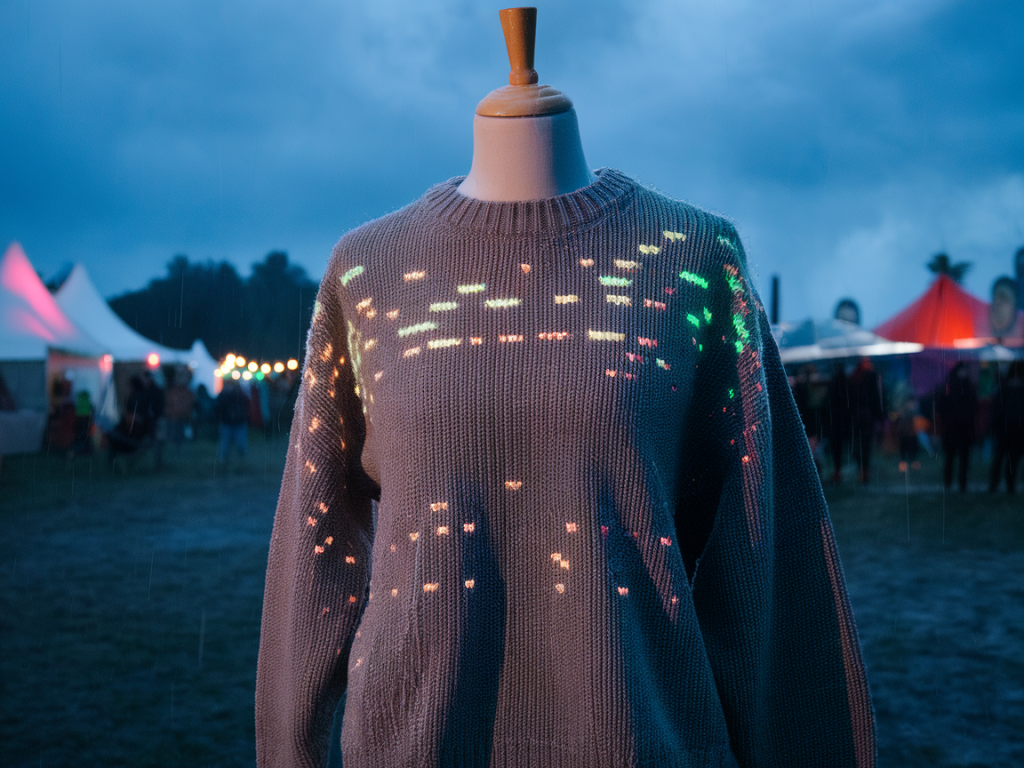
Rain at a festival has a way of softening the world: umbrellas, steaming cups of tea, and the low hum of music through wet air. It also throws a tricky, beautiful challenge at anyone trying to photograph or display knitted work: textured stitches that look glorious in daylight can flatten into mud under sodium lamps or dreary grey skies. Over the years I've learned to favour small, portable lighting — and a little microdisplay tech — to make knit textures sing on rainy festival evenings. Below I share the setups I use, why each element matters, and a few product suggestions that travel well between pitches and marquees.
What do I mean by "microdisplay lighting"?
When I say microdisplay lighting I’m talking about two linked things: compact lighting units (micro lights) and small, handheld displays or monitors (microdisplays) that let me preview how light falls across a stitch at close quarters. Micro lights are tiny LEDs you can rig to a clamp, stand, or even a knitting needle; microdisplays are pocket-sized screens—like the SmallHD Focus or an iPad Mini used as a monitor—that help me judge texture and shadow detail in real time.
Why small lights and displays work for rainy festival settings
There are a few constraints at festivals that make micro solutions ideal:
Portability: you’re carrying yarn, samples, business cards — so light gear is a must.Quick setup: weather changes fast; you need to get a shot or show a piece to a customer in minutes.Close-up control: knit texture is a small-scale subject. Precise, directional light beats a big softbox when you want stitch definition.Battery power and weatherproofing: micro lights often run on rechargeable batteries and are easier to shelter under a makeshift awning.Key lighting principles for textured knits
Before brand names or rig diagrams, keep these ideas in mind:
High CRI (Color Rendering Index) — choose lights with a CRI of 90+ so your yarn colours and subtle fibre sheens render accurately.Warmth and neutrality — I prefer 3000–4000K for a cosy, realistic look that flatters natural fibres; 5600K can work for daylight-balanced scenes but can feel harsh in wet evenings.Directional grazing — to show stitch texture, position a key light at an oblique angle so the light grazes across the surface, making ribs, cables, and bobbles pop.Soft diffusion — use small diffusers or softboxes to avoid ugly specular highlights while keeping the shadows that add depth.Controlled fill — a tiny fill from the opposite side (or a reflector) prevents shadows from swallowing stitch detail.My go-to micro lights and how I use them
I keep a small kit that fits in a shoulder bag and survives drizzle when I’m on a stall or backstage at a folk tent.
LitraTorch 2.0 — tiny, waterproof, mountable. Excellent as a rim light or small key when I want a pinpoint of warmth to lift texture. Magnetic base helps attach to metal tent poles.Aputure Amaran AL-MC / AL-M9 — compact, high-CRI, with adjustable color and decent diffusion. Great as a soft key; I often clip one to a little articulating arm and angle it across a knitted swatch for grazing light.Godox ML60 / Godox RGB LED panels (micro versions) — slightly larger but still portable; give more power for wider shots. Use them when I need to light a whole display table while keeping a textured close-up for social media content.Small battery-powered LED panels (generic) — I favour ones with dimmers and an included diffuser. They’re affordable and rugged; I stash gel sheets to tweak warmth if the ambient light is too blue.Microdisplay tools I use on-site
It’s one thing to light a swatch; another to be sure stitch definition is what you want. Enter the pocket display.
SmallHD Focus 5" — gives a real-time look at how light sculpts stitch texture when tethered to a mirrorless camera. Helps to check for blown highlights and lost shadows.iPad Mini or old tablet used as a tethered monitor — with camera apps that preview the frame, this is a budget-friendly microdisplay solution. It’s also useful to show customers close-up photos of your work.Phone with macro lens — sometimes the simplest microdisplay is someone’s phone with a clip-on macro lens. I tether it to a mini tripod and use the screen to fine-tune small lights.How I rig a typical rainy-evening setup
Here’s a walk-through of my favourite portable rig for capturing stitch texture under a damp festival canopy.
Step 1: Shelter and base — find an overhang, the inside edge of a marquee, or hang a waterproof tablecloth to block wind and drifting rain. Dampness changes the look of yarn; keep it dry and sheltered.Step 2: Key micro light (grazing) — place an Aputure AL-MC or LitraTorch on a small articulating arm to the side at roughly 30–45 degrees to the plane of the fabric, slightly above it. Angle down so the light skims the stitch tops — this makes texture read.Step 3: Diffusion — clip a small soft diffuser or use tracing paper in front of the light if the LEDs create harsh hotspots. You still want a defined shadow edge, just not blown highlights.Step 4: Fill — on the opposite side, use a dim LitraTorch or a folded white reflector to lift excessive darkness. Keep it subtle; too much fill will flatten the texture.Step 5: Rim or backlight — add a tiny light behind the sample if you want separation from a dark background. This is especially effective for lacework, where a backlit edge shows openness and thread detail.Step 6: Microdisplay check — set your camera to tether and preview on the SmallHD or tablet. Zoom into the stitch area to check for lost highlights, correct tilt of the light, and whether the yarn’s colour is true.Practical festival tips: weatherproofing and quick fixes
Festival life demands improvisation. These are tricks I reach for in drizzle or mud.
Zip-locks and silicone tape — keep a few lights in zip-lock bags while in transit; use silicone tape to seal connectors from spray.Umbrella clamp — mount a micro light under a small umbrella for a fast sheltered key light.Gaffer & safety pins — secure wires and small stands; you don’t want a gust to ruin a shot or customer demo.Portable power — a 20,000 mAh power bank with USB-C output keeps lights alive all evening. I have a dedicated battery bag for the neatest swaps.When to choose warmth vs. cool
On rainy evenings I usually dial for warmer tones — around 3200–3800K — because they recreate the cosy feel of festival lamps and bunting. If you’re photographing brightly dyed yarn where colour fidelity is vital, match the lights to your camera white balance or use a neutral 4000–4500K and rely on a high-CRI source so colours remain accurate.
Examples from the field
Last summer, under a canvas awning and a steady drizzle, I used an AL-MC grazing across a cabled jumper sample while a LitraTorch gave a faint fill. The stitches took on a sculptural depth: shadows nestled between cable ribs, and the backlight picked up the halo of a slightly fuzzy yarn. I showed a customer a close-up on my iPad Mini as we chatted over tea — the microdisplay made it possible to discuss stitch choices and colour shifts without lugging a tripod or studio kit.
If you’d like, I can sketch a printable gear checklist for a single-person festival lighting kit (fits in a tote), or put together a short video demonstrating grazing angles with the different micro lights. Tell me which lights you already own and I’ll tailor the setup to what you carry.