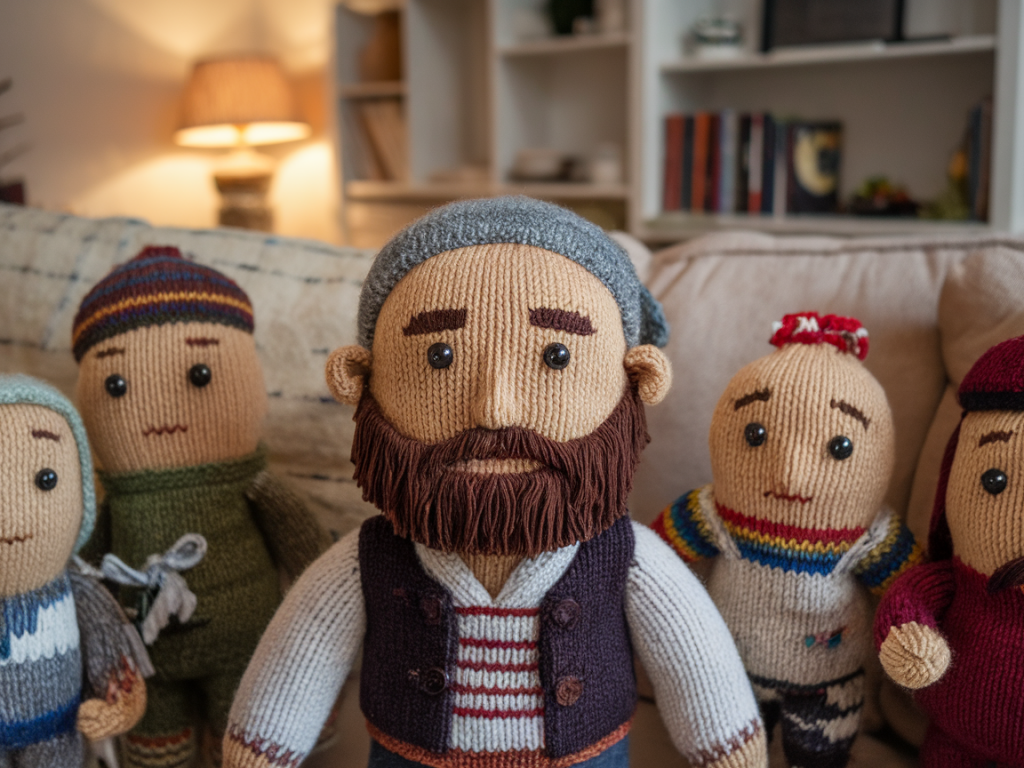
I often think of knitted characters as tiny actors on a patchwork stage: their stitches are costumes, their stuffing is posture, and their maker is the director who gives them a voice. Over the years—between festival marquees and kitchen-table pattern-testing—I’ve learned that a believable voice for a knitted character doesn’t come only from a label or a sewn-on smile. It’s woven from choices you make while designing, knitting, and finishing. Here are five storytelling techniques I use to give my characters voices that feel lived-in and ready to tell tales at a folk festival stall or in the quiet of a kitchen window.
Give your character a physical voice
By “physical voice” I mean the way a character’s body, pose, and materials communicate personality before a single stitch of dialogue is imagined. When I design, I think about how a sloped shoulder, a jaunty hat, or a slightly off-centre button eye speaks. These are subtle but powerful cues.
Try these prompts while you knit:
At a recent craft fair I displayed a set of tiny troubadours where one had a dramatic, high collar made from reclaimed wool. People immediately assumed that character was pompous and theatrical—before I’d even improvisationally voiced them. The materials did half the storytelling for me.
Let dialect and rhythm shape speech
A voice is more than the words; it’s rhythm, pacing, and sound. When I’m creating dialogue for a character, I read their lines aloud in different cadences until one feels true. Festival life introduced me to accents and storytelling cadences that inspired several of my characters—some with clipped town-vendor briskness, others with the long, winding sentences of an elder sharing a tale by candlelight.
Consider:
For example, one of my market characters—a retired fairground rigger now knitted in cozy tweed—speaks slowly and deliberately, using old tradesman terms. That rhythm immediately made them feel anchored in a lifetime of hands-on work.
Build a backstory that informs habits
Backstory isn’t an essay you need to print; it’s a tool you use when choosing details. A believable voice grows from a lived life. Where did your character come from? What festivals, markets, or kitchens shaped them? A few well-chosen biographical facts will influence the phrases they repeat, the jokes they tell, and what they value.
Questions I ask when crafting backstory:
These small objects often become scripts: the character pulls out the ticket stub and tells the same story each time—its cadence, its ending, its signature punchline. Repetition is a storyteller’s friend; it solidifies voice.
Use props and costume as voice amplifiers
In my workshops I encourage makers to think of accessories as instruments that change how their characters speak. A scarf embroidered with names will make your character refer to “my friends” in a particular way. A patchwork satchel suggests someone who collects stories and trinkets, and they will likely tell stories that begin with “I once found…”
Useful techniques:
At a summer folk festival my little shepherd doll wore a hand-woven sash that visitors immediately asked about. That single prop led me into a short, recurring anecdote about a sheep named Mabel—complete with laugh lines and a distinctive sigh that became part of the doll’s voice.
Anchor voice in sensory detail and memory
Stories feel true when they include sensory memories: a character might never say “I’m homesick,” but they can speak of “the scent of damp hay at dawn” or “the metallic tang of fairground candy.” These specifics do the heavy lifting of credibility and give you footholds for consistent speech.
How to weave sensory detail:
When I craft scripts for market storytellers, I prompt them to lead with a sensory image: “The first thing I felt when I arrived at Granny’s gate was the woolly smell of the henhouse.” Those small details make listeners lean in.
Finally, remember that voice grows with use. Test your characters at stalls, in storytelling circles, and at festivals. Film quick snippets on your phone and listen back—often, what you think will read one way becomes another when spoken. Editing speech for performance is part of the process: remove the overlong sentence, amplify the catchphrase, or give them a soft laugh that punctuates every tale.
Voice is not a single tweak but a tapestry of choices—materials, rhythm, backstory, props, and sensory memory. Knit those threads together deliberately, and your characters will feel like relatives you can’t help but listen to when they begin to speak.