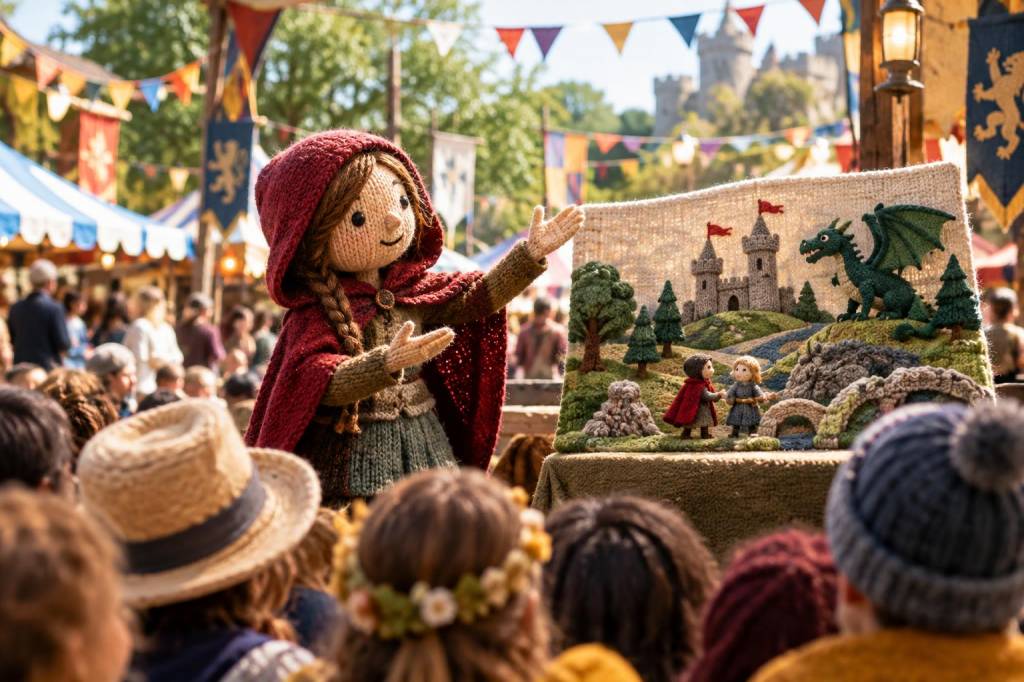
I often think a knitted character can speak most clearly when no spoken dialogue is available at all. In a crowded festival, words can disappear into drumbeats, food stalls, laughter, and the press of moving feet. Yet a small figure made from yarn can still carry a full folktale if I give careful thought to posture, color, rhythm, and sequence. A knitted character does not need a microphone to be heard. It needs presence, and presence can feel louder than speech.
Why silence can feel stronger than speech
At a busy festival, silence is rare, which is exactly why it can feel powerful. When I place a knitted figure into a lively setting, I am not trying to compete with the noise. I am trying to create a pause inside it. A listener passing by may not stop for a long explanation, but they will stop for a tiny fox with a stitched scar, or a woolen grandmother carrying a basket, or a green-faced river spirit sitting on a stump. The eye catches what the ear misses.
Without dialogue, I have to rely on visual logic. Every detail becomes part of the tale. A tilted head can suggest curiosity. A frayed sleeve can suggest travel. A bright red shawl can suggest danger, grief, celebration, or protection, depending on what surrounds it. I like that ambiguity. It invites people to fill in the missing words with their own imagination, and that makes the story feel personal very quickly.
In my experience, a folktale told without speech often feels more ancient. So many oral traditions were shaped through gesture, repeated images, and familiar symbols. A character did not need to explain everything aloud, because the audience already knew the forest meant change, the river meant crossing, and the bell meant warning. When I knit for festival display, I try to remember that older visual language.
Building story into every stitch
I start with character design, but I never think of it as decoration only. The yarn, texture, and construction are narrative tools. If I am making a trickster, I may use uneven stripes and slightly mismatched buttons. If I am making a guardian, I may use dense stitches, a firm stance, and a grounded palette. If I am making a lost child from a folktale, I may leave one sleeve a little too long or one shoe deliberately mismatched, because those small choices suggest vulnerability.
Color matters more than people sometimes expect. At a crowded festival, strong contrast helps a character remain visible from a distance, but contrast also creates emotional meaning. Deep blue can feel like moonlight, secrecy, or water. Mustard and rust can suggest autumn, old songs, or household warmth. White yarn can make a figure seem fragile, ghostly, or blessed. I use color as a mood cue first and as a visual anchor second.
Texture carries meaning too. Smooth yarn can feel ordinary and human. Boucle can suggest age, moss, or a creature from the edges of the map. Felted sections can make a character seem weathered by weather and time. Even the direction of stitches can matter. I have often found that a character with a slightly rougher surface feels more lived-in, as if it has already crossed a few roads before arriving at the festival.
Gesture becomes language
When a knitted character cannot speak, I make sure it can gesture in a readable way. A raised arm is not just a pose; it can be a greeting, a warning, a plea, or a blessing. A character leaning forward can seem eager to listen. A character turned away can suggest a secret, a refusal, or a moment of hesitation. I often test poses by standing a figure across the room and asking myself whether I can guess its emotional state without any labels.
Hands are especially important. A tiny hand holding a spoon, a thread, a lantern, or a seed tells visitors something immediate about the role of the character. If I want to hint at a tale of generosity, I place something open in its palms. If I want to hint at a tale of theft or mischief, I let the hands hover too close to an object that does not belong to them. Small details like that give the audience a path into the narrative.
I also think about eye placement. A knitted face with eyes set slightly wide apart can feel innocent or dreamy. Eyes placed lower on the face can make a character seem solemn or patient. If I embroider a mouth at all, I keep it subtle, because I want expression to come mainly from the whole body rather than from a single feature. That approach makes the figure easier to read from a distance in a noisy environment.
Using festival space as part of the tale
A knitted character never stands alone at a festival. It exists among tents, banners, food aromas, dancing feet, and other performers. I like to treat that environment as part of the storytelling rather than as a distraction. If I am showing a woodland tale, I may place the character near branches, leaves, bark, or woven texture that echoes a forest floor. If I am showing a sea tale, I may use reflected blue cloth, shells, rope, or curved displays that suggest tide movement.
The route people walk also matters. A visitor usually notices a stall or display in stages: a shape at a distance, a color as they draw closer, then a face, then a detail. I design for that sequence. From far away, I want a strong silhouette. Up close, I want small rewards such as stitched beads, tiny satchels, or embroidered symbols that reveal more of the tale. This layered approach keeps the character interesting whether someone spends ten seconds or ten minutes with it.
Sound can support silence too. If a character belongs to a tale about rain, I might place it beside a soft rustle of fabric. If it belongs to a tale about a courtship dance, I might set it near music with a gentle rhythm. The character never needs to speak, because everything around it helps carry the story forward.
Creating a tale arc without words
A folktale still needs movement, even when it has no spoken dialogue. I usually think in scenes. First comes the ordinary world, then an interruption, then a choice, then consequence, and finally a transformed ending. A knitted character can embody any one of those moments, or a display can include several figures that show the progression across space.
For example, I might create a fox figure beside an unbroken berry basket, then a second figure with berries scattered across the table, then a third figure with a full pouch and a suspicious grin. A visitor can read that sequence instantly. No narration is required. The story is already there in the arrangement.
Another useful method is repetition with variation. If I make several small characters using the same body shape but different accessories, I create the feeling of a family, a village, or a chorus of witnesses. Repetition gives structure. Variation gives meaning. Together they can suggest a tale of inheritance, rivalry, or communal memory.
| Visual choice | Possible story effect | Festival benefit |
|---|---|---|
| Bright contrast colors | Clear emotional signal | Easy to spot in a crowd |
| Asymmetrical clothing | Suggests mischief or imperfection | Draws close attention |
| Small prop in hands | Signals action or role | Improves instant readability |
| Low, grounded stance | Feels stable, ancient, protective | Works well on display tables |
| Open posture | Invites curiosity and trust | Encourages people to approach |
Making visitors part of the storytelling
I love when a festival audience completes the tale in their own minds. A child may look at a knitted bird and decide it escaped from an enchanted forest. An older visitor may see the same bird and remember a family story about omens, migration, or weather signs. Because the character does not speak, it leaves room for memory. That openness is not a weakness. It is part of the craft.
Sometimes I place a few clue objects nearby rather than giving a full explanation. A key, a lost shoe, a red apple, a small bell, or a torn ribbon can prompt immediate questions. People lean in. They ask one another what happened before and after the moment they are seeing. In that way, the knitted character becomes a conversation starter even though it never utters a single line.
I also find that silence creates a gentler kind of participation. Not everyone wants to be addressed directly at a festival. Some people prefer to observe first and imagine privately. A wordless knitted character gives them permission to do that. They can meet the story at their own pace, without pressure, and that often makes the experience feel more intimate.
What I ask myself while I am knitting for a noisy space
Before I finish a character intended for a festival crowd, I ask a few questions. Can this figure be read in a glance? Does its posture tell a story without explanation? Does its color support the mood? Is there at least one detail that rewards a second look? If I can answer yes, I know I am close to a successful wordless folktale.
- Can a stranger understand the mood from a distance?
- Does one small prop reveal a clear role or conflict?
- Does the silhouette remain strong among moving people?
- Does every detail support a single emotional direction?
- Can a child and an adult each read something different into it?
I find that a knitted character tells a folktale without spoken dialogue by becoming a vessel for clues, rhythm, and memory. It does not explain itself in sentences. It offers shape, color, texture, and pose, then trusts the audience to complete what is missing. In a busy festival, that trust can be magical. It allows story to travel through the eyes, through the body, and through the shared air of the gathering, where everyone is already listening in their own way.