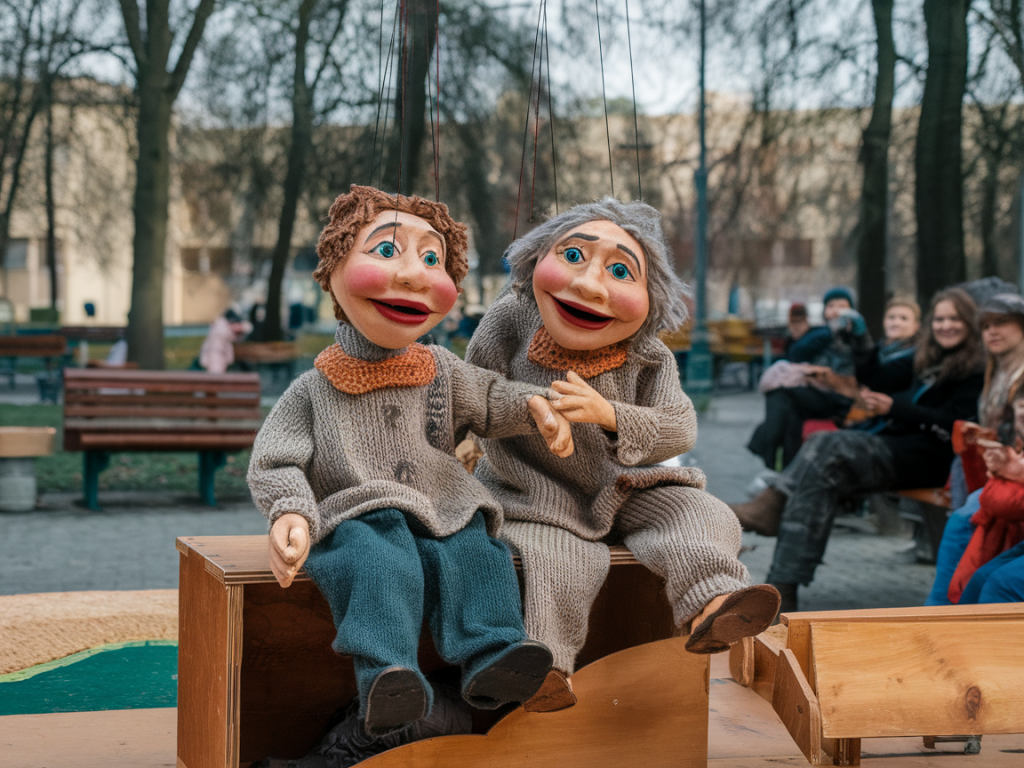
I once wondered the same thing: can two small knitted puppets really keep an audience rapt for a 20‑minute folk tale outdoors? After years of taking woolly characters into village greens, festival fields and courtyard stages, I can say yes—if you plan the staging, pacing and sound carefully. Here are the practical tricks I use when a pair of knitted performers must carry the whole show on their own, with nothing but craft, voice and a bit of festival magic.
Why a duo works (and what it asks of you)
A two‑puppet setup is intimate and charming. It invites relationship: conflict, friendship, banter, chorus work. That intimacy becomes a strength outdoors, too, if you make the scale readable and the rhythms clear. The main demands are:
- Clear character definition — each puppet must have a distinct silhouette, voice and movement palette so the audience can follow who’s speaking.
- Strong staging — simple, bold blocking rather than elaborate props, so the story reads from a distance.
- Sound strategy — projection, ambient noise and weather can drown subtle voices, so plan amplification or acoustic tricks.
- Varied pacing — twenty minutes is long enough to lose attention; vary tempo, physicality and texture to stay engaging.
Shaping the 20‑minute tale: structure and pacing
I think of a 20‑minute folk tale as a three‑part journey: set‑up, complication, and resolution/aftertaste. But within those parts I carve beats—moments of action, reflection, song or audience address—so the story breathes.
Try this beat map:
- Opening tableau (30–60 seconds): a strong visual that states the world and the two characters’ relationship.
- Inciting moment (2–3 minutes): the problem or quest is introduced.
- Rising scenes (8–10 minutes): short, distinct episodes or obstacles—the duo moves through these with clear goals.
- Climax (2–3 minutes): the highest emotional/physical point, where the pair must act together.
- Resolution + lingering image (3–4 minutes): tie strands up, then leave a tactile image or a small song to carry the feeling away.
Within scenes keep exchanges short and varied. Alternate fast banter with slow, poetic lines. Physical beats—one puppet climbs, the other hides, a sudden partnered lift—reset attention and create visual punctuation. The knitted texture of your characters plays beautifully here: little hands, small gestures, tactile pauses.
Staging outdoors: scale, sightlines and simple props
Outdoors you need to make sure gestures read to the back. I favour:
- Exaggerated silhouettes: hats, capes, or knitted wings help characters read at distance.
- Raised platform: even a low riser (30–40 cm) improves sightlines. When festivals ban platforms, I use a blanket with a bright border to frame the playing area.
- Minimal, modular props: one chair that flips to become a gate, a knitted tree trunk that’s also a satchel—pieces must transform quickly so scene changes feel seamless.
- Entrances and exits: keep them clear and visible. The audience should see where characters come from and return to; it helps glue the narrative together.
Movement language for two knitted puppets
I teach a few simple rules to ensure clarity:
- Distinct walk — one puppet might be bouncy, the other slow and shuffling. Even with hand puppets, rhythm of movement signals character.
- Shared beats — create moments where both puppets move in unison (a dance, a shared look). These build intimacy and are emotionally satisfying.
- Texture shifts — switch from slow, careful knitting‑like gestures to broad arm movements to mark changes in emotion or stakes.
Voice, projection and sound tricks
Voice is where a duo either flourishes or gets lost. Outdoors, projection is challenging—wind, chatter and distance sap subtlety. Consider these options:
- Narrator + voices — keep one human narrator (offstage or slightly to the side) to set scenes or provide connective tissue. This frees the puppets to be more immediate and snappy.
- Wearable mics — tiny lavs clipped to puppeteer clothing or discreetly embedded in a puppet’s chest can help, but they need wind covers.
- Battery PA systems — portable solutions like the Roland Street Cube or JBL EON One Compact are festival staples: lightweight, battery powered, and good for small crowds.
- Acoustic tricks — project slower, with clear vowels and pausing; use call‑and‑response to pull the audience in; sing one simple chorus so bodies remember the melody even if some words are lost.
| Option | Pros | Cons |
|---|---|---|
| Wearable lav mic | Natural sound, hands‑free | Requires wind protection, tech setup |
| Handheld mic | Simple to use, robust | Breaks puppet illusion if visible |
| Battery PA (compact) | Good coverage for small crowds, reliable | Must be positioned; battery life to check |
| No amplification | Pure acoustic charm | Limited reach, vulnerable to noise |
Sound design that doesn’t need a sound tech
A few simple sonic layers can make a huge difference: a small hand‑drum, a shruti box app on a phone tucked offstage, or a tiny Bluetooth speaker playing looped textures. I often use a smartphone running the free app "AUM" or a tiny looper (Boss RC‑1 is a budget favourite) to create recurring motifs that cue the audience emotionally. Keep loops short and low in mix so they support rather than compete with the voices.
Audience dynamics and interaction
Outdoors you have to accept movement: dogs, wanderers, festival goers. Invite participation early. A small question, a raised hand for a chorus, or asking a child to "guard" a knitted trinket makes people stake a social claim in the story. This reduces wandering and increases attention without breaking the spell.
- Use direct address sparingly and warmly—too much breaks the story’s world.
- Give the audience a simple ritual: clap once when the puppets nod, hum the chorus, or stamp feet on cue. These repeated actions act like footholds through longer stretches.
Weather, durability and practical tips
Knitted puppets are lovely but sensitive. Bring waterproof covers, a small drying towel, and a kit: safety pins, strong thread, spare buttons, and a glue gun. If rain’s likely, build a quick canopy with poles and a tarp—audiences at festivals expect shelter and you keep your characters safe.
Also rehearse with the space. I always do a quick sightline walk with a friend sitting at the back; if gestures vanish, amplify or increase movement scale. Test any tech with the ambient noise level—generator hums and food stalls will surprise you.
Final practical checklist
- Beat map of the tale with 6–8 clear scene changes
- Distinct voices and movement patterns for each puppet
- Simple props that can transform quickly
- Amplification plan (even a tiny PA) and spare batteries
- Audience participation hooks and a closing sensory image
- Repair kit, weather plan and sightline rehearsal
When it all comes together—the two knitted figures lit by a low sun, a small loop humming in the background, and a chorus of the audience humming the last line—you realise the true power here isn’t size or spectacle, but intimacy and craft. A knitted puppet duo can absolutely carry a 20‑minute folk tale outdoors, if you give them clear shape, bold movement and sound that reaches the people who matter most: the listeners.