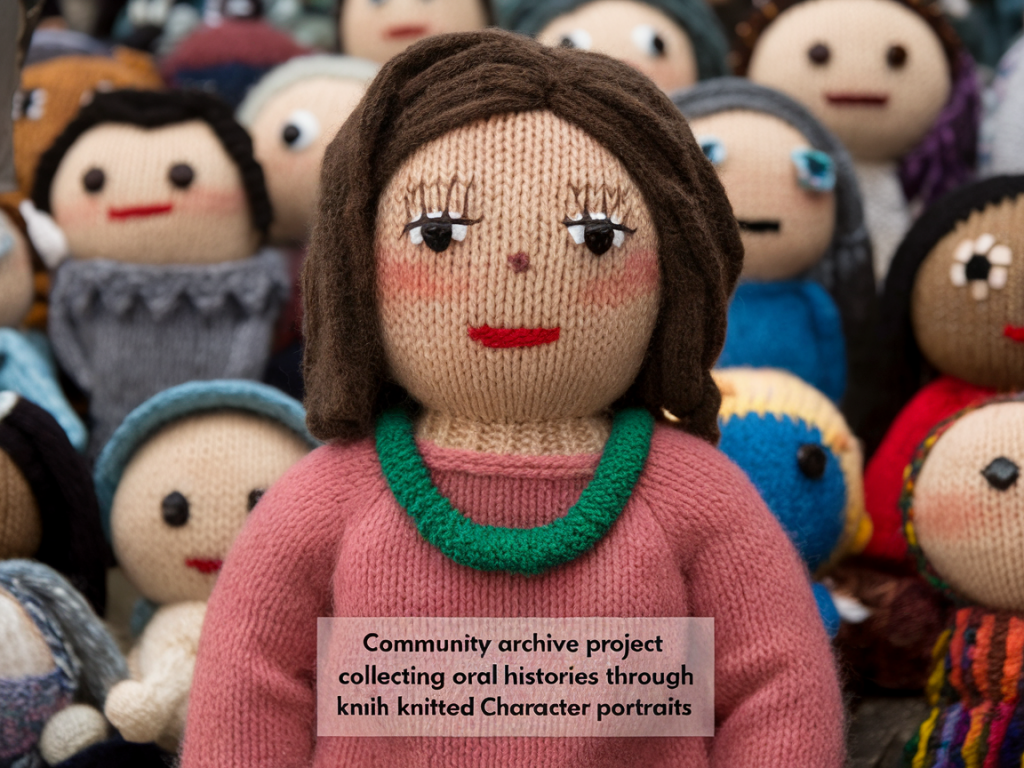
I first started sketching this project after a long rainy afternoon at a village fête where a Morris troupe warmed up under canvas canopies. The dancers’ faces—lined, laughing, intense—stayed with me, as did the tiny knitted fox I’d bought from a stall, complete with a stitched scarf that made it look like it had just arrived from a brisk country lane. I realised then that people carry their stories in small, tangible ways: a favourite hat, a well-worn program from a festival’s first year, or a toy knitted by a grandmother. The Community Archive Project grew from that feeling: collecting oral histories through knitted character portraits that translate memory into craft, and craft back into memory.
Why knitted character portraits?
Knitted characters are more than cute objects. They’re mnemonic devices that invite storytelling. A tiny jumper can prompt an elder to recall a winter spent teaching marching steps to a youth band; a finger puppet can evoke a childhood spent in the front row of a folk concert. Creating a knitted portrait—small, portable, and tactile—lets us open doors that formal interviews sometimes can’t.
I wanted an archive that felt accessible and playful, one that honoured oral histories without making them solemn museum pieces. Knitted portraits allow participants to co-create: they pick colours, suggest little props, or recount the scent of the wool used in a childhood jumper. These choices become documentary evidence of memory as much as any audio file.
How the project works: a step-by-step approach
Below is the workflow I’ve been refining at festivals, maker markets, and community halls. It’s flexible—designed to be portable enough for festival life, but rigorous enough to build a usable archive.
Practical knitting tips for portrait-making
When you’re producing knitted portraits in a pop-up situation, speed and recognisability matter. Here are a few techniques I use:
Interview prompts that evoke rich memories
People wonder how to get beyond surface anecdotes. I find that concrete prompts, sensory cues, and gentle follow-ups help stories bloom:
These questions often link craft, folk performance, and even sport: a woman may recall knitting a snug cap for her son before his first rugby match; a drummer might remember a festival afterparty where someone mended a sock and changed the mood of the whole crew. Sport’s physicality—practice, ritual, uniform—frequently appears in these recollections, especially in communities where local matches sit alongside fetes on the social calendar.
Ethics, storage and making the archive useful
Creating an oral archive carries responsibility. I follow a few principles:
Sharing the work: exhibitions, festival stalls and sports halls
Knitted character portraits are wonderfully portable for sharing. I’ve mounted mini-exhibitions in festival marquees, displayed a line of portraits in a village sports pavilion, and held listening stations where visitors press a button and hear a story while holding the knitted character that inspired it.
Interactive formats work best: pair a portrait with a QR code linking to the audio clip and a small printed card with context. At a recent folk festival, we staged a “telling tent” where attendees could sit, listen, and then knit a badge to take home—another small act of participation that keeps the archive living.
Collaborations I’ve seen work
Every portrait we add becomes a node in a larger network: of makers, players, musicians, and listeners. The knitted character is a bridge between remembrance and present-making, a small, soft archive that invites hands, voices, and the occasional cup of tea.