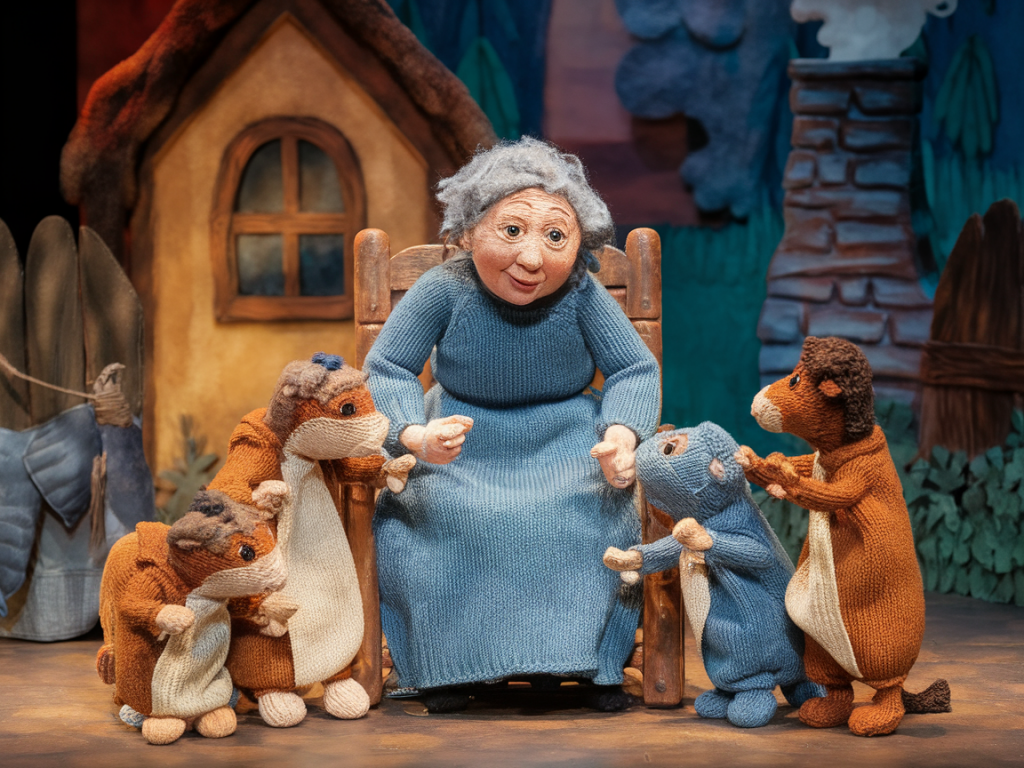
I love turning old stories into small, knitted lives — the kind you can cup in your hands and send skittering across a tabletop stage. Adapting a traditional folk tale into a short, puppet-style knitted performance is one of my favourite creative challenges: it asks you to be a maker, a storyteller, a director and a performer all at once. Below are the steps and practical tips I use when taking a tale from its oral roots to a tidy, festival-ready knitted show.
Choose the right tale
Not every folk tale suits a short knitted performance. I start by asking a few simple questions: Is the story compact? Does it have vivid characters? Can its main beats be visualised with just a handful of props? A trickster tale with a clear beginning, middle and end often works well. So do tall tales with an episodic structure — you can pick one or two episodes to show rather than the whole saga.
When working with traditional material, I always check the tale’s provenance and any cultural sensitivities. If a story belongs to a specific community, it’s important to seek permission and, if possible, collaborate. I aim to celebrate rather than flatten cultural nuance — even in a five-minute performance.
Simplify the story structure
A short performance needs a tight spine. I reduce the tale to its essential beats: setup, complication, climax, and resolution. Then I ask: what can be shown visually, and what must be spoken? Puppetry loves action, so I try to move as much as possible into gestures and movement.
- Keep the arc to 3–5 scenes.
- Identify a single emotional through-line (e.g. curiosity, courage, cleverness).
- Trim subplots that don’t serve that through-line.
Cast with knitted characters
My knitted puppets are tiny ambassadors of personality. For a short performance, I limit the cast to two or three characters. This keeps knitting time manageable and makes the staging clearer for audiences.
Think about puppet types:
- Finger puppets — charming and quick to knit; great for intimate, close-up settings.
- Hand puppets — offer more expressive movement for arms and mouths.
- Rod or stick puppets — excellent for larger gestures and when you want limbs to move independently.
Mixing types can be delightful — a larger hand puppet interacting with tiny finger puppets creates a playful scale contrast. I use DK or aran weight yarns for durable, festival-friendly puppets; brands like King Cole or Cascade provide colours that hold up well under light and cameras.
Design for expressiveness
Small knitted faces don’t need much to read well. I focus on clear silhouettes and a few key features:
- Contrasting hats or hair for easy recognition.
- Embroidered eyebrows or sewn-on felt eyelids to suggest mood.
- Removable accessories (a scarf, a tiny crown) to show character change.
I often use safety eyes for puppets that won’t be given to very young children; for festival shows where kids might handle the puppets afterward, stitched features are safer. For speedy production, modular bodies with interchangeable heads or hats let me reuse parts across characters.
Write a puppet-friendly script
Scripts for knitted puppetry should be lean. I write in short beats and add stage directions that are specific to puppetry: lift arm, nudge stage-left, whisper into puppet ear. Keep language vivid and rhythmic; repetition works brilliantly for audiences of all ages and helps non-verbal beats land.
Include sound cues and pauses — a well-timed silence can make a knit mouse's tiny scream hilarious. For a two to seven minute piece, aim for about 300–900 words depending on pacing and the amount of silence or music you’ll use.
Plan staging and props
My stages are portable: a simple wooden box, a fabric-fronted table, or a fold-out puppet booth. Consider sightlines — if you’re outdoors at a festival, raise your stage so a standing crowd can see. Use bold, tactile props: felt trees, painted wooden stones, and fabric rivers. These read well even from a distance and withstand repeated use.
| Scene | Approx. Duration | Key Prop |
|---|---|---|
| Setup | 30–60s | Small house or cloak |
| Complication | 60–120s | Obstacle (river/door) |
| Climax | 60–120s | Transformation item |
| Resolution | 30–60s | Shared object (tea cup/flag) |
Sound, music and timing
Sound elevates a knitted puppet show. I often use a small Bluetooth speaker and brief musical motifs to signal scene changes. Traditional tunes — a fiddle reel or a simple drone — can anchor a story in its cultural setting, but keep permissions in mind and use public-domain or commissioned snippets when possible.
Timing is everything. Rehearse with a stopwatch until your beats are consistent. Puppetry is forgiving, but audiences sense hesitation. If you have a performer’s tendency to speed up, insert a deliberate pause or a physical gag to control tempo.
Rehearse with movement and voice
I rehearse puppetry in front of a mirror and record myself. It’s shocking how often gestures look different on camera than in my head. Focus on clear, readable actions: a small nod, a big hat toss, a hand-to-heart. For voices, aim for contrast between characters rather than mimicry — a higher pitch for the small, quick puppet and a lower, slower cadence for the grander one.
Practice transitions between puppets too: if you’re performing multiple roles, rehearse switching puppets quickly and silently. Lay out each puppet in performance order so swaps become muscle memory.
Audience interaction and accessibility
Short knitted performances are perfect for gentle interaction. I like ending with a small question or an invitation to handle a puppet under supervision. For sensory-friendly audiences, offer a quiet performance time with lower volume and minimal sudden movements.
Provide a brief synopsis on a sign for those who are hard of hearing, and use clear gestures that supplement speech. Consider printed patterns or tactile storytelling materials at your stall to extend the experience beyond the live show.
Legal and ethical considerations
When adapting traditional tales, credit your sources. If you’ve adapted a tale from a collectors’ volume, cite the collector and, when relevant, the community of origin. If a tale is recent or has living custodians, seek permission. This is not only respectful — it can lead to richer collaborations.
Finally, treat your knitted characters as ambassadors: label them with care instructions and, if you sell them at a festival, include a short note about the story they come from. People love the context — it makes the puppet feel like a tiny vessel of living tradition.
There’s a special kind of alchemy when a hand-knit creature tells an age-old tale: the yarn carries texture and memory, and the puppeteer breathes new life into old words. If you try this process, start small, keep it playful, and let the festival crowd's laughter guide your rhythms. I’m always thrilled to hear how others adapt their favourite tales — drop me a line if you’d like feedback on a script or pattern.