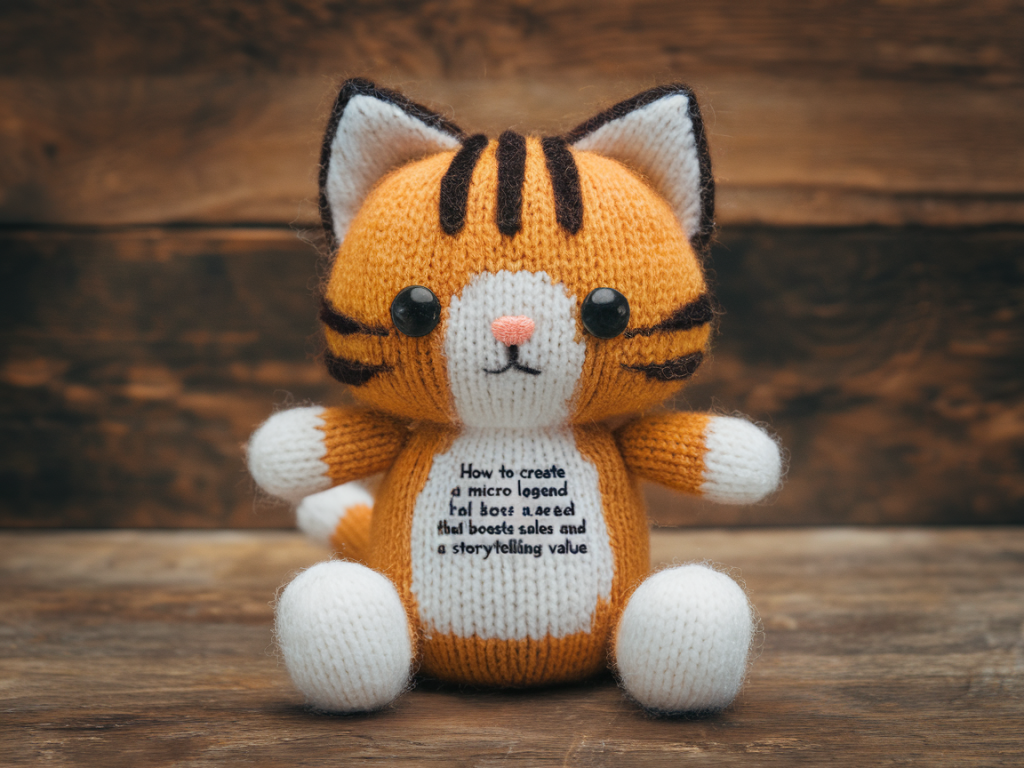
I love the moment when a tiny knitted being steps off my needles and into the world — and the first question I ask is not only "Who is this creature?" but "What story will help it find a home?" A micro-legend is the little burst of narrative you attach to a knitted character that makes it feel lived-in, memorable, and irresistible to buyers. Over the years, I’ve seen how a well-crafted micro-legend can lift a piece from cute object to cherished companion, increase sales at market stalls, and seed conversations that lead to commissions. Below I share how I build these mini-myths, with practical prompts, examples, and ways to use them across listings, tags, and festival displays.
What is a micro-legend and why it matters
A micro-legend is a concise, evocative backstory — usually one to three sentences — that gives your knitted character a personality, a small mystery, or a role in a larger folklore-like world. It doesn’t need to be a full biography. Think of it as the blurb on the back of a storybook: an invitation rather than a manual.
Here's why I treat them as essential:
Emotional connection: People buy feelings as much as objects. A hint of history or a quirky habit makes a toy feel like a friend.Differentiation: In saturated marketplaces like Etsy or craft fairs, a micro-legend helps your piece stand out.Story-led marketing: Short, sharable lines work perfectly for Instagram captions, product tags, and festival signage.Principles I use when crafting a micro-legend
I keep four small rules in mind when I write micro-legends. They keep the stories tight and market-friendly.
Keep it succinct: One to three sentences. If I can’t describe the spark in that space, I simplify.Anchor in detail: A single sensory detail (the smell of bonfire smoke, a patch on the elbow) makes the character tangible.Suggest a role: Is the character a festival guardian, a pocket companion for good luck, or a travelling minstrel? Roles help buyers imagine use.Leave room to imagine: I rarely explain everything. A small mystery invites customers to create their own stories.Step-by-step: Building a micro-legend
Follow this quick workshop I use at markets or when preparing product pages.
1. Note the visual hook: What’s the first thing you notice? A striped scarf, a chipped button eye, oversized ears.2. Choose a setting: Where does this character belong? A hearth, a festival field, a bookshelf, a caravan?3. Pick a small act: What does it do daily? Collects lost tunes, mends faded socks, guards picnic crumbs.4. Add a twist: A quirk or secret: dreams of the sea, speaks only to children, is made from leftover wedding yarn.5. Edit down to 1–3 sentences: Remove commas, keep only evocative nouns and verbs.Example workflow:
Visual hook: Tiny red scarfSetting: Folk festival campsiteAct: Keeps embers alive each morningTwist: Hums a tune learned from a fiddlerMicro-legend: "Small and warm in a red scarf, Ember watches over the festival fire, humming the tune a fiddler once taught her. She promises not to go out — only to sparkle new mornings." (This can be tightened when used in a tag.)Formats and where to place a micro-legend
Different contexts call for different lengths and tones. Here are formats I rotate between:
Label line (10–15 words): For swing tags and price cards — quick and memorable.Product blurb (1–3 sentences): On websites or market catalogues — slightly more atmospheric.Story card (50–80 words): Printed card included with the purchase — gives the buyer a keepsake and talking point.Social caption (20–40 words): For Instagram or Facebook posts — invite shares and comments.Examples to inspire you
Below are three short templates you can adapt. Replace the bracketed elements with your own details.
| Template | Example |
| "[Name] keeps [small task] by [habit]. Rumour says [quirk]." | "Maggie keeps soles mended with a thimble and a song. Rumour says she once stitched a map into a boot." |
| "Born by [place], [name] travels with [object]. They collect [thing]." | "Born by the riverside, Finn travels with his folded umbrella. He collects songs people forget." |
| "[Name] is the [role] of [space] — if you listen at [time], you may hear [sound]." | "Nettle is the lullaby-keeper of the stall canvas — if you listen at dusk, you may hear her whistle old tunes." |
Using micro-legends to boost sales
I’ve tested a few tactics that work especially well at festivals and online:
Include a free story card: A printed micro-legend tucked in a parcel raises perceived value and encourages social shares when buyers photograph their new character.Use as a tag line in listings: Put the 10–15 word line under the product title on Etsy or your site; searchers read it quickly and remember it.Tell the story at your stall: Rehearse a 15-second version to say to passersby. A human voice telling a tiny myth outsells a silent row of toys every time.Make a repeatable series: Create a "festival folk" line (Ember, Nettle, Finn) so collectors come back to complete the set.Handling FAQs buyers might have
When a micro-legend sparks questions, I use them as opportunities to deepen engagement rather than dispel the magic.
Q: Is the micro-legend true? A: "It's true as a story — each character is inspired by real moments and people at the festivals I love."Q: Can I request a custom legend? A: "Yes — I sometimes write personalised cards for gifts, adding a name or a memory to the tale."Q: Do you copyright these stories? A: "I keep the original micro-legends for my pieces but love to hear how buyers make new stories with them." If you’d like, I can help you craft a micro-legend for a character you’re currently making — tell me the visual hooks and I’ll sketch three short options you can use on tags, listings, and social posts.